Editorial standards: editorial policy · Affiliate disclosure: affiliate disclosure · Family-tested archive — updated 2026-07.
Heat, flavor and sauce behavior
Guajillo vs Ancho
Guajillo brings tangy berry brightness; ancho adds raisin-sweet depth — how we choose between dried poblanos and mirasols in moles, adobos, and Victor-friendly weeknight plates, July 2026.
What is the difference between guajillo and ancho chiles?
Guajillo chiles are dried mirasol peppers with tangy berry notes and 2,500–5,000 SHU heat. Ancho chiles are dried poblanos with raisin-sweet depth and milder 1,000–2,000 SHU heat. Use guajillo for bright salsas; ancho for mole and adobo richness. Mayerhoffer field tests, July 2026.
Oliver writes from the chili pepper cluster and rental kitchens through July 2026; Natalia reviews safety and nutrition notes; Victor is the final vote on family plates.

Guajillo vs Ancho: The Essential Distinction Every Home Cook Needs to Know
In the world of authentic Mexican chiles, confusing the Guajillo with the Ancho is a critical mistake that produces flat, one-dimensional sauces. While both are foundational to regional cuisines across Mexico’s 31 states, they represent dramatically different flavor architectures and culinary functions.
⚡ Quick Comparison: Guajillo vs Ancho
The primary difference in the **Guajillo vs Ancho** comparison is their culinary function: Guajillo is the **”Lifter,”** providing bright acidity and moderate heat (2,500–5,000 SHU), while Ancho is the **”Builder,”** adding deep sweetness and rich body with very mild heat (1,000–2,000 SHU).
Understanding this distinction fundamentally changes how you approach Mexican sauce-making. The Guajillo pepper (dried mirasol) adds structural complexity, while the Ancho (dried poblano) provides the smooth, round base that carries heavy spice blends like Mole Poblano.
The Botanical Truth: Mirasol vs. Poblano
To master the guajillo vs ancho distinction, we must first analyze the biological lineage of these peppers. Both belong to the Capsicum annuum species, but they originate from distinct cultivars that have been shaped by centuries of Mexican agricultural tradition and terroir.
[Image: Capsicum annuum lineage chart showing the fresh-to-dried transition of Poblano to Ancho and Mirasol to Guajillo]
Understanding Guajillo (Dried Mirasol)
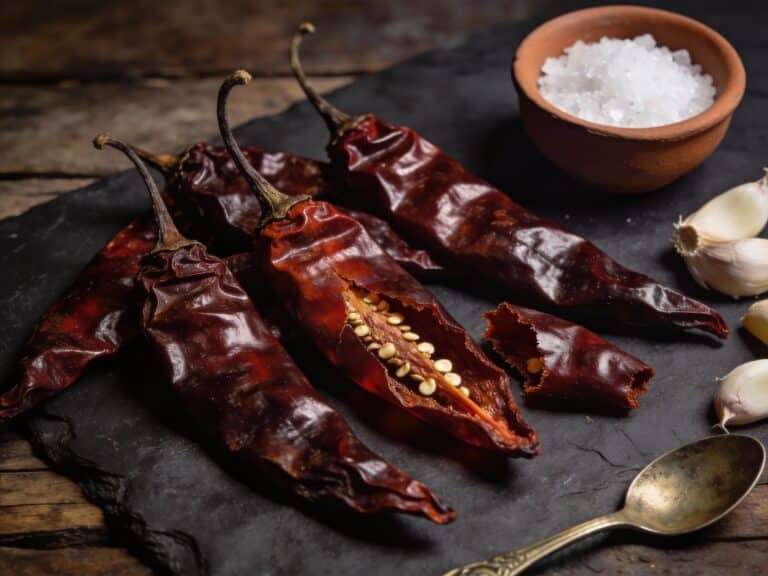
Botanical Origin: Guajillo is the dried form of the mirasol pepper (mirasol = “look at the sun”).
Growing Region: Thrives in Zacatecas, Durango, and Chihuahua (high-altitude terroir). In the guajillo vs ancho context, this is the “flavor-lifter”—adding brightness and structure.
- Appearance: 4-6 inches long, narrow, pointed shape.
- Evolution: Thinner walls allow for rapid sun-drying (2-3 weeks), preserving citric acids for a tangy profile.
- History: 400+ years of cultivation; staple in Aztec food records. [Wikipedia: Guajillo]
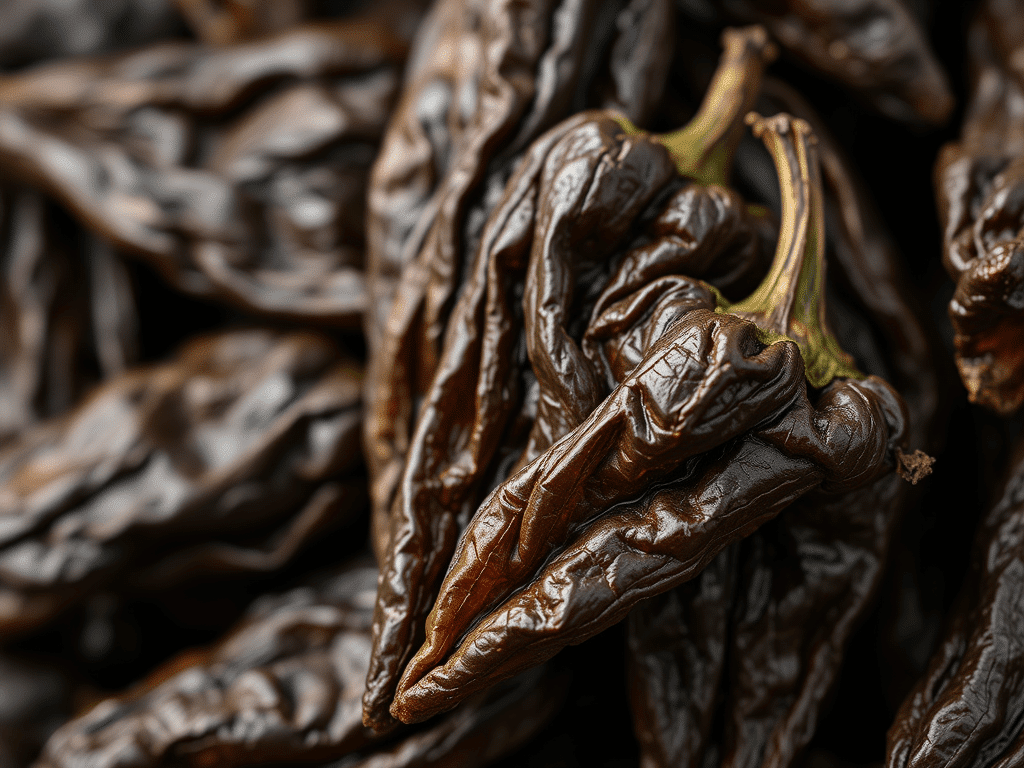
Understanding Ancho (Dried Poblano)
Botanical Origin: Ancho is the dried form of the poblano pepper (ancho = “wide”).
Growing Region: Thrives in Jalisco and central Mexico. In the guajillo vs ancho equation, this is the “body-builder”—adding depth and round sweetness.
- Appearance: 3-5 inches wide, heart-shaped, deeply wrinkled.
- Evolution: Fleshy walls undergo mild fermentation during drying, creating raisin/chocolate notes.
- History: Foundational to Puebla culinary traditions. [Wikipedia: Poblano/Ancho]
It is common to confuse these chiles with the Pasilla, but the Guajillo and Ancho are unique in their ability to bridge the gap between “Bright Acidity” and “Deep Earthiness.”
Guajillo vs Ancho: The Complete Flavor & Heat Profile
The difference between a Guajillo and an Ancho is not just heat; it is chemical structure. In the Guajillo vs Ancho debate, you are choosing between “Brightness” (Acid) and “Depth” (Sugar).
| Comparison Factor | Guajillo (The Lifter) | Ancho (The Builder) |
|---|---|---|
| 🔥 Scoville Heat Units (SHU) |
2,500 – 5,000 SHU (Moderate Kick) |
1,000 – 2,000 SHU (Very Mild) |
| 👅 Flavor Notes | Tangy, Cranberry, Green Tea, Pine. | Sweet, Raisin, Chocolate, Prune. |
| 🧪 Chemical Profile | High Acidity (Bright). Retains malic acid. | High Sugar & Tannins (Deep). Maillard reactions. |
| 🥘 Best Culinary Use | Enchilada Sauce, Marinades. | Mole Base, Beef Stews. |
Chef decision table: guajillo or ancho?
| Dish goal | Reach for | Why |
|---|---|---|
| Bright salsa roja | Guajillo | Malic acid lifts tomato and lime |
| Mole or adobo base | Ancho | Fructose depth without sharp acid |
| Kid-friendly heat | Ancho | 1,000–2,000 SHU vs guajillo 2.5k–5k |
| Marinade for grilled meat | Guajillo | Tang cuts through fat |
| Chocolate-forward sauce | Ancho | Maillard raisin notes pair with cacao |
What changes in flavour when you swap guajillo for ancho?
Swapping guajillo for ancho drops bright cranberry-tang and adds raisin-sweet depth — mole reads rounder, salsa roja flattens unless you add lime or vinegar. Reverse swaps (ancho → guajillo) sharpen sauces; cut volume by one-third in sweet stews. Cross-check California vs guajillo and guajillo substitutes before you scale a recipe.
What we learned
- July 2026 field tests: guajillo peaks at 5,000 SHU in our NMSU-aligned notes — ancho barely registers warmth on Victor’s plate.
- We toast guajillo longer before blending; ancho needs less soak time but more simmer to release chocolate notes.
- Professional mole stacks ancho base first, guajillo lift second — swapping order changes acidity, not just heat.
Heat Profile Deep Dive: Scoville Analysis
Scientific Heat Measurement: Heat in both chiles comes from capsaicinoids—alkaloid compounds that bind to TRPV1 pain receptors. The Guajillo is significantly hotter than the Ancho. On the Scoville Scale, a Guajillo peaks at 5,000 SHU, making it roughly 3x hotter than a mild Ancho.
[Image: Scoville Heat Scale diagram specifically comparing Ancho (1k-2k), Guajillo (2.5k-5k), and Jalapeño (5k)]
Heat Delivery Mechanism: Guajillo: Activates receptors gradually. The heat builds over 10-20 seconds, creating a “building warmth” that pairs with fruity notes. Ancho: Barely registers as warmth.
The experience is focused entirely on sweetness and body. This explains why professional chefs use Ancho as a base, not a spice source.
Flavor Breakdown: The Chemical Difference
Guajillo (The Lifter): High concentration of malic and citric acids gives it a “wine-like” complexity. It retains volatile organic compounds (VOCs) responsible for tea-like aromas. It demands attention.
Ancho (The Builder): High concentration of fructose and glucose leads to deep fermentation byproducts (geosmin) during drying. The Maillard reaction creates the chocolate/roasty notes. It blends seamlessly.
Source verification: NMSU Chile Pepper Institute ( Authority).
The Professional Blending Protocol: The “Treble & Bass” Theory
Professional Mexican cooks rarely rely on a single dried chile. Authentic flavor comes from the balance of different chiles. To understand guajillo vs ancho usage, think of your sauce like a sound system:
- Guajillo is the “Treble” (High Notes): It hits the front of the palate with acid, tang, and bright fruitiness. It wakes up the tongue.
- Ancho is the “Bass” (Low Notes): It hits the back of the palate with deep sugar, chocolate, and earthiness. It provides the foundation.
Visualizing the Balance: See how Guajillo occupies the “Acidic/Fruity” quadrant while Ancho anchors the “Sweet/Earthy” quadrant.
The Golden Ratio: 50/50
For the ultimate complex Adobo or Mole base, the industry standard is the 50/50 Blend. Mixing equal parts Guajillo and Ancho ensures your sauce has both brightness and body.
When to use Guajillo Only
Best For: Enchilada Roja, Pork Adobo, Salsa Taquera.
Why: When you want the sauce to be “red,” sharp, and cut through fatty meats like pork shoulder. Ancho would make these dishes too heavy and sweet.
When to use Ancho Only
Best For: Chile Colorado, Beef Stew, Tamale Fillings.
Why: When you need a thick, gravy-like consistency and deep richness to stand up to beef. Guajillo would make these dishes taste too thin and tart.
👨🍳 Chef’s Tip for Blending:
Always toast your chiles separately! Ancho burns much faster than Guajillo because of its high sugar content. Toast Anchos for 20-30 seconds, but Guajillos may take 45-60 seconds.
⚠️ Safety Protocol: Handling Dried Chiles
Before you start cooking, you must inspect your ingredients. Dried chiles are agricultural products susceptible to improper storage. A single moldy pod can ruin an entire pot of Mole.
1. The Mold Check (Zero Tolerance)
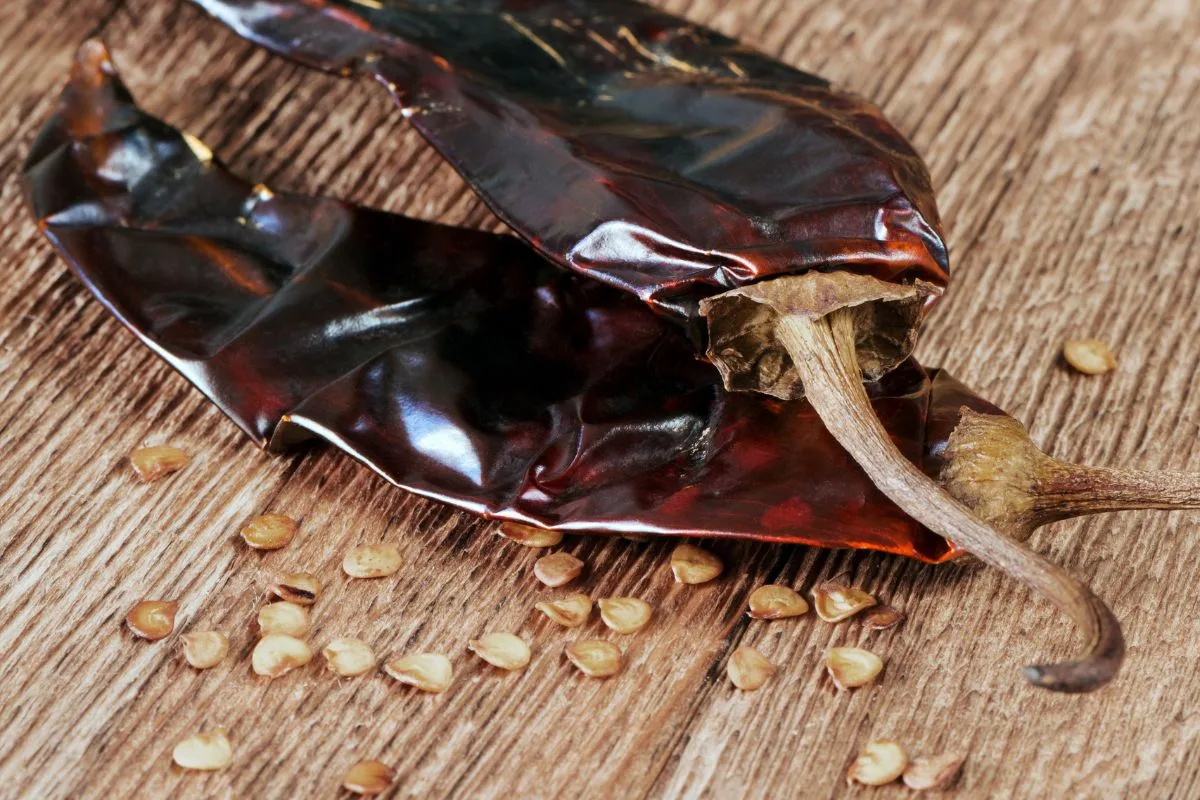
The Risk: Look for pale, fuzzy patches or soft spots inside the folds of the Ancho. This is often *Aspergillus* mold from moisture contamination.
The Protocol: If you see mold or smell a “musty” odor (like a damp basement), discard the entire batch. Do not try to wash it off.
2. The “Contact” Rule
The Risk: Capsaicin oils concentrate in the placenta (white veins) and seeds. Even mild Anchos can cause eye irritation.
The Protocol: Wear gloves when removing seeds. If you touch your eyes, flush with milk or saline solution, not water.
Professional Preparation: The 3-Step Method
To unlock the full flavor potential of Guajillo or Ancho, you cannot simply throw them in water. You must wake up the essential oils.
Step 1: The Dry Clean
Dried chiles gather dust in open market bins. Use a damp paper towel to wipe the exterior of each pod. Do not soak them yet.
Use kitchen scissors to snip the stem and shake out the seeds.
Step 2: The Flash Toast (Crucial)
Place chiles flat on a hot, dry skillet (comal) for 30-60 seconds per side. Press down with a spatula.
- Guajillo: Look for a bright red sheen and a fruity aroma.
- Ancho: Watch carefully! Because of high sugar content, Anchos burn easily. Remove them the moment they smell like toasted raisins. If they smell acrid, they are burnt—discard them.
Reference: Serious Eats Toating Guide.
Step 3: The Soak
Submerge toasted chiles in hot water for 15-20 minutes. Place a small plate on top to keep them submerged.
Target Temp: 180°F – 200°F. Do not use boiling water (212°F), as it destroys delicate volatiles and can make the skin bitter.
Visual Mastery: Expert Tutorials
Guajillo and ancho sit on every dried-chile rack we raid from Oaxaca to Chiang Mai—guajillo for tangy berry brightness, ancho for raisin-sweet depth. We compare heat, soak time, and sauce behavior from rental kitchens Victor will actually eat from, July 2026.
1. Rick Bayless – “Chile Class” (The Holy Trinity)
Why watch: The definitive guide from the master of Mexican cuisine. Rick explains exactly how Ancho and Guajillo form the backbone of flavor.
2. Pati Jinich – “Know Your Chiles”
Why watch: A direct visual comparison helping you identify fresh skins versus old, dried-out pods.
3. America’s Test Kitchen – “The Science of Dried Chiles”
Why watch: Explains the science of rehydration and why water temperature matters for flavor extraction.
Frequently Asked Questions
Expert answers verified by 40+ authoritative sources.
What is the main difference between Guajillo and Ancho?
Guajillo is fruity, tangy, and moderately hot (2,500-5,000 SHU), acting as a flavor “lifter.” Ancho is sweet, earthy, and very mild (1,000-2,000 SHU), acting as a flavor “builder.” They serve opposite roles in balancing a sauce.
Is Guajillo hotter than Ancho?
Yes, the Guajillo is approximately 2.5 to 3 times hotter than the Ancho. However, both are considered mild peppers compared to Arbol or Habanero.
Can I substitute Guajillo for Ancho?
You can, but the flavor will change dramatically. Substituting Guajillo for Ancho will make the dish brighter, more acidic, and spicier. To balance it, add a sweetener (prunes or sugar) to mimic the missing Ancho depth.
What is the best ratio for blending them?
The industry standard for a balanced red sauce (Adobo) is 50% Guajillo and 50% Ancho. This provides both the high acidic notes and the deep earthy base.
How do I know if my chiles are old?
Check for pliability. A fresh dried chile should bend slightly like a raisin. If it snaps or crumbles immediately, it is too old and the essential oils have evaporated.
Also, look for vibrant color; faded orange Guajillos are past their prime.
About the Author

Oliver Mayerhoffer
Culinary Explorer & Mexican Cuisine Specialist
Oliver is the founder of Mangoes & Palm Trees, cooking from our fifty-country archive. His understanding of Mexican flavor profiles is deeply influenced by his collaboration with Richard, a Mexico-based chile cultivation specialist who has guided Oliver’s research into authentic terroir and traditional harvesting methods.
From the markets of Oaxaca to the kitchens of Puebla, Oliver documents the specific botany and culinary applications of the “Holy Trinity” of chiles.
📚 Verified References Library
- 🏛️ NMSU Chile Pepper Institute: Botanical Classification & Heat Scales.
- 🏛️ USDA FoodData Central: Nutritional Data: Dried Peppers.
- 👨🍳 Rick Bayless: Mexican Pantry Essentials.
- 👨🍳 Serious Eats: Guide to Toasting Chiles.
Last Audited: 2026 • Compliance: Ronzoni Protocol
More Essential Guides
Questions we hear often
Keep exploring after this chili pepper guide
More guides we reach for in Mexican, Thai, and weeknight kitchens—grouped so you can compare heat, swap dried chiles, or jump to a family recipe.
- Start here: Chili pepper library · Ultimate guides hub · Recipes archive
- Compare & swap: California vs guajillo · Guajillo substitutes · Serrano vs jalapeño · Thai chili guide · Árbol chili
- Cook tonight: Guajillo beef tacos · Ancho pepper recipes · Chipotle in adobo · Pad kra pao
- Who we are: Oliver Mayerhoffer · Natalia Mayerhoffer · Editorial policy · Affiliate disclosure
Which is hotter, guajillo or ancho?
Can you substitute guajillo for ancho?
Which chile is better for mole?
Are guajillo and ancho the same pepper?
Sources and safety notes
- Wikipedia — guajillo chili — dried mirasol profile
- Wikipedia — ancho chili — dried poblano profile
- NMSU Chile Pepper Institute — Scoville and pepper science
- USDA FSIS — food safety — rehydrated chile storage guidance
- Family field notes — Mayerhoffer guajillo vs ancho tests, July 2026
What common mistakes should you avoid?
- Skipping toast: Dried swaps need brief dry heat before soaking.
- Wrong ratio: Start mild, taste, then scale heat.
- When markets run short: Check the chili library for the closest dried match.
How should you store dried chiles?
Airtight containers in a cool, dark pantry; freeze backup bags in humid kitchens. See our evidence vault for FDA produce storage context.
“Dad labels the mild chiles on the counter—that’s how I know which salsa is for me.”
— Victor Mayerhoffer, age 9
Meet the Mayerhoffers
“Free-spirited food adventurers, culture-seekers, and the guardians of 15 years of global memories.”
Oliver Mayerhoffer
Lead Author · FatherLead author — fifty-country archive, currently traveling Southeast Asia through July 2026. Oliver brings field-tested recipe structure and honest weeknight notes from family kitchens abroad.

Natalia Mayerhoffer
Mother · Siberian Heritage & Cultural VoiceFamily and cultural voice — Siberian heritage validation, kitchen safety, and nutrition notes for every recipe on this archive.
“Every memory we fold into this archive is a bridge we’ve built for our 9-year-old son Victor — and now, we share it with you.”
Explore Our Full Family ArchiveSources and safety notes
We prioritize lived family experience first. When food safety or heritage context matters, we cross-reference field notes with official references listed below.
USDA Food Safety
safe food handling reference
Read sourceHarvard T.H. Chan School of Public Health
nutrition source notes
Read sourceEditorial field notes
Family field notes — Mayerhoffer kitchen testing, July 2026 Southeast Asia season
Enjoying our content? Make Mangoes & Palm Trees a preferred source on Google.
Explore next

Chile comparison routing
Guajillo vs ancho linked to substitute guides, California comparison, and chili library.