Skip to recipe
The Quick Answer

How do you make raspberry-apple champagne slushies?

Blend two cups of raspberries with one cup of unsweetened apple juice and two tablespoons of triple sec until smooth. Add three cups of ice and blend to a thick slush. Divide between chilled glasses, then top each with cold Brut champagne or dry sparkling wine and garnish. For a non-alcoholic pour, swap the wine for chilled sparkling apple cider.

Welcome to the Mangoes & Palm Trees family archive. The botanical base of this drink is Rubus idaeus — the cultivated red raspberry that carries enough natural acidity to stand up to ice and sparkling wine without turning thin. We pair it here with crisp apple juice and a dry Brut pour, the same proportions we’ve kept since refining frozen drinks on Koh Chang back in 2015.

For broader context on raspberry-led drinks before you commit ice to the blender, BBC Good Food’s raspberry cocktail edit is a sensible browse — we still prefer apple juice in this build because it sits more quietly behind raspberry than citrus does. Below: full method, three curated technique videos, the variations served at home (including Victor’s alcohol-free pour), and the family-led FAQ answering the questions readers send us most.

Why This Recipe Works: Acidity Carries Frozen Fruit

The drink lives or dies on a single decision — a dry, acidic sparkling wine instead of a sweeter style. Raspberries already carry their own sugar, and so does apple juice; layering on a sweet sparkling wine produces something thick and sticky on the palate. A Brut or Extra Brut (under 12 g/L of residual sugar by EU labelling rules) does the opposite: it cuts the fruit, lifts the aromatics, and keeps the second sip as bright as the first.

The structural rule: blend a stable slush base first, then pour something fizzy at the very last moment. Bubbles introduced before the ice will collapse in the blender; bubbles poured into a chilled, structured slush stay lively for the duration of a glass. We learned this discipline making frozen drinks on Koh Chang, and the same logic shapes our Isla Sangria frozen margaritas.

Raspberries themselves do a great deal of the work for free. According to the USDA FoodData Central reference for raw raspberries, a one-cup serving carries roughly 5–6 grams of natural sugar alongside meaningful fibre and vitamin C — the reason the finished glass tastes complex even though the ingredient list is short.

The acidity rule is well-documented in serious mixology too — recipe writer Philippa Davis notes the same thing when building raspberry-led drinks: the fruit reads better against a sharp counterweight than against more sugar.

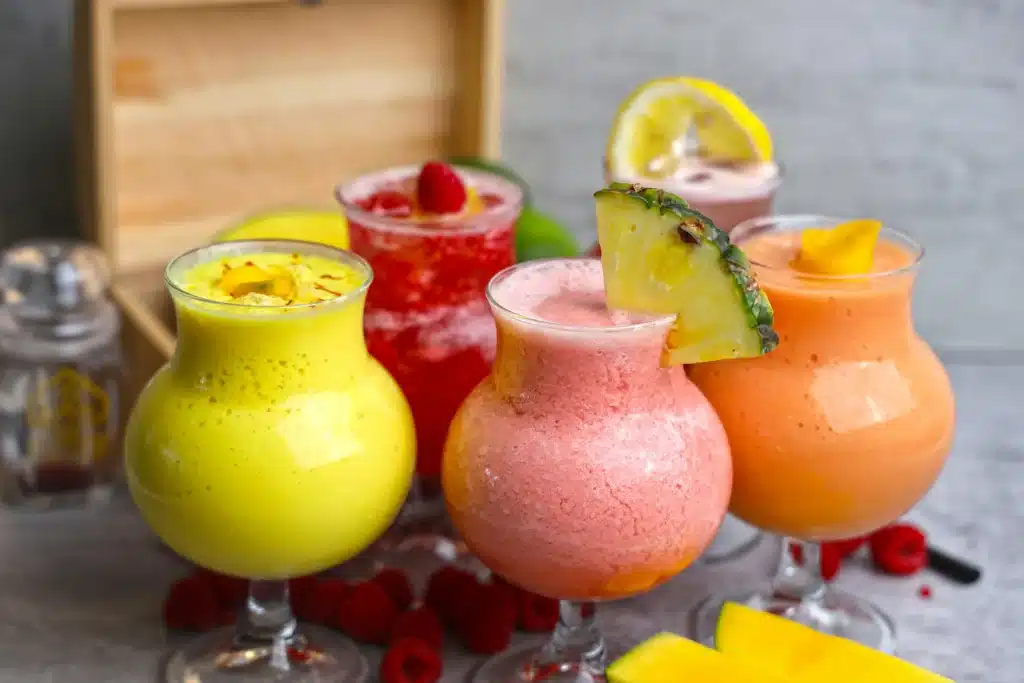
Raspberry-apple champagne slushies served in chilled coupe glasses, garnished with fresh raspberries and mint
The finished pour: stable slush base, dry sparkling wine layered on top.

The Ingredient Architecture: Six Lines, Three Roles

Every ingredient in this drink plays one of three roles: flavour (raspberries, apple juice), structure (ice, triple sec), or lift (sparkling wine, garnish). Understanding which role each ingredient is doing means you can swap with confidence — most variations on the page below are simply different flavour or lift choices around the same structural backbone.

Serves 4–6 · 5 minutes

Shopping list

  • 2 cups raspberriesFresh or frozen; frozen actually behaves better here.
  • 1 cup unsweetened apple juiceCloudy / pressed style preferred for body.
  • 2 tbsp triple secCointreau or any standard orange liqueur.
  • 3 cups ice cubesStandard freezer cubes; not crushed ice.
  • 1 × 750 ml dry Brut sparkling wineChampagne, Cava, or any dry-labelled sparkling.
  • Fresh raspberries & mintTo garnish; a single sprig per glass.
Sourcing & Substitution Lens

What to look for at the shop

For the apple juice, read the label and choose unsweetened, single-strength juice rather than a juice “drink” or “cocktail” with added sugar — the difference at the glass is significant. Quick at-a-glance comparisons can be made via NutritionValue.org or EatThisMuch; for raw fruit composition cross-check against the USDA FoodData Central reference.

For the sparkling wine, anything labelled Brut, Extra Brut, or Brut Nature works well; “Sec” or “Demi-Sec” bottles will read as too sweet against the fruit. Spanish Cava and Italian Franciacorta Brut are reliable, affordable substitutes for Champagne. If you’d rather skip alcohol entirely, chilled sparkling apple cider — the Martinelli’s sparkling fruit drink family is a clean, widely available example — is the cleanest swap; lemon-lime soda is a softer, sweeter alternative used for Victor’s pour.

For more on stocking a sensible global pantry, see our ingredient guides and broader recipe index.

The Recipe

The Mayerhoffer Method

Method

Step by step

  1. Build the slush baseCombine raspberries, apple juice, and triple sec in a high-speed blender. Blend until completely smooth, about 30 seconds.
  2. Add the iceAdd ice and blend on high until the mixture rides the blade as a thick slush, roughly 45 seconds. Pause and scrape the sides if it seizes; loosen with one tablespoon of cold apple juice (not water) if needed.
  3. Chill the glasswareIf you have time, slip your coupe or wine glasses into the freezer while you blend. Cold glass meaningfully slows the melt at the top.
  4. Layer the slushDivide the slush between glasses, filling each about two-thirds full. Leave room for the sparkling wine to climb without overflowing.
  5. Top with sparkling winePour chilled Brut sparkling wine slowly over the slush so the bubbles stay lively. The fizz will lift through the fruit and create a clean line at the rim.
  6. Garnish & serve immediatelyAdd a fresh raspberry and a single mint sprig per glass. Serve at once with a short straw and a small spoon — this drink is not built to wait.

Family note: Victor’s version uses chilled sparkling apple cider in place of wine, poured the same way. The texture and theatre of the bubbles are what he’s actually there for.

Curated Video References

Method is easier to absorb visually than in writing. Below are three independent demonstrations we trust on YouTube — each illustrates a specific lever (texture, citrus balance, sorbet base) without overlapping with the others. All credits link directly to the creators’ channels.

Blender texture & ice ratio

Why this clip: the creator handles the ice-to-liquid balance the way we do — slush stays on the blade, not spinning freely. That’s the texture you’re aiming for.

Credit: third-party YouTube demonstration · technique reference only

Citrus balance for frozen pours

Why this clip: shows what happens when you swap apple juice for sharper citrus — useful if you’re considering the limeade variation lower down the page.

Credit: Tipsy Bartender

Sorbet-based luxury build

Why this clip: swaps raw ice for a fruit sorbet, producing a smoother, more dessert-like texture — useful for formal table service. Bake School’s granita guide covers the same temperature-control logic in writing.

Credit: Food52

Want more pours on camera? Browse our video recipe archive or the cocktail recipe hub.

Three Variations We Actually Serve at Home

Each version below changes a single role in the recipe — the lift, the flavour, or the fruit — while leaving the structural slush base alone. That’s why they all work without re-engineering the proportions.

Family pour

The kid-friendly version

Replace the sparkling wine with chilled sparkling apple cider; the carbonation does the same lifting work without alcohol. Pour at the very last moment, the same way as the original. This is Victor’s daily request through summer.

More family blends →
Stone fruit

Peach-champagne twist

Replace the raspberries with two cups of frozen ripe peaches; keep everything else identical. Wyld Flour’s peach-champagne slush uses similar proportions and is a useful sanity-check.

Service Notes: Three Levers That Decide the Glass

If something is going wrong with this drink, it’s almost always one of these three things — temperature, glass, or timing. Get them right and the recipe holds even if everything else is approximate.

Lever 1 · Cold chain

Everything cold, all at once

Cold sparkling wine, cold glasses, frozen or very cold raspberries. Warm fruit produces a watery slush, full stop — the most common failure mode in any recipe of this style.

Lever 2 · Glass choice

Wine glass over flute

A coupe or wine glass holds the slush better than a narrow flute. The wider opening also lets the bubbles work through the fruit instead of trapping them under a tight column.

Lever 3 · Timing

Pour the wine last, not early

Top with sparkling wine right at the moment of service. Even ten minutes ahead of guests means flatter foam and a softer rim. This drink is built to be poured and immediately handed across the table.

Frequently Asked Questions

For broader cooking and entertaining questions, our wider family food & travel FAQ covers the full archive.

Can I make raspberry-apple champagne slushies ahead of time?

Yes — blend the slush base up to 24 hours ahead and store it in a shallow container in the freezer. Before serving, break it up and pulse briefly in the blender, then divide between glasses and top with sparkling wine at the very last moment so the bubbles stay lively.

Avoid pouring the wine into the base ahead of time; once carbonation enters the freezer, it disappears.

What can I use instead of triple sec?

A measured splash of fresh orange juice is the cleanest substitute, with a few drops of orange extract if you want more aromatic lift. Taste the smooth blender base before you add ice and adjust upward in small increments rather than guessing.

If you want a different citrus dimension entirely, the lemonade direction works — the famous Honey Deuce cocktail uses lemonade behind raspberry to similar effect.

How can I make this drink less sweet?

Use unsweetened apple juice and choose a dry sparkling wine labelled Brut, Extra Brut, or Brut Nature. If the blended base still tastes too sugary, balance it with one teaspoon of fresh lemon juice before adding the ice — the acidity will sharpen the fruit without changing the body.

Sweeter sparkling labels (Sec, Demi-Sec, Doux) will read as cloying against ripe raspberries; skip them for this build.

What is the best champagne or sparkling wine for slushies?

A dry Brut or Extra Brut is best — the acidity balances ripe fruit without adding sugar. Affordable Spanish Cava, Italian Franciacorta Brut, or California sparkling wines all work well; you don’t need a vintage Champagne for a frozen drink, only one labelled clearly as dry.

If you only have a sweeter bottle on hand, bump the lemon juice slightly to compensate.

Editorial Cross-Checks

Sources & Further Reading

The recipe is built on lived practice. Where a claim touches numbers — sugar content, fruit composition, sparkling-wine sweetness levels — we cross-reference public, authoritative data so a reader can audit it themselves.

Reference Used for Verification link
USDA FoodData Central Raspberry & apple juice composition Lookup raw foods
Wikipedia · Raspberry (Rubus idaeus) Botanical context for the fruit Read entry
BBC Good Food Raspberry cocktail context Browse recipe edit
Smitten Kitchen Limeade variation cross-check View original
Wyld Flour Peach-champagne proportion check View original
Bake School Raspberry champagne granita technique Read guide
Philippa Davis Acidity-as-counterweight in raspberry drinks View recipe note
Martinelli’s Sparkling fruit drink (alcohol-free) reference Browse recipes
NutritionValue.org Apple-raspberry juice quick lookup View entry
EatThisMuch Apple-raspberry juice secondary lookup View entry
Tipsy Bartender (YouTube) Citrus-balance video reference Visit channel
Food52 (YouTube) Sorbet-base variation reference Visit channel

Curators of the Mangoes & Palm Trees Archive

Oliver Mayerhoffer, hospitality lead and culinary explorer for Mangoes and Palm Trees

Oliver Mayerhoffer

Author · Hospitality Lead

Oliver writes the drinks the family actually serves at home — measured pours, cold glassware, and frozen builds that don’t separate five minutes after they hit the table. The slush ratios on this page were refined on Koh Chang and have travelled with the household ever since.

More from Oliver
Natalia Mayerhoffer (DMD), editorial reviewer for Mangoes and Palm Trees

Natalia Mayerhoffer (DMD)

Editorial Reviewer

Natalia reviews recipes for clarity, sourcing language, and household practicality — particularly anywhere a sentence touches sugar levels, alcohol substitution, or family-friendly variants. The kid-safe pour on this page is here because she insisted on it.

More from Natalia
Make it tonight

A short list, a cold glass, dry bubbles

If the wine is dry and the glasses are cold, the rest takes care of itself. Pour at the very last moment and serve straight away — this drink is built for the table, not the fridge.

Family-led, hospitality-trained, built around real pours and a glass our nine-year-old still wants in the room.

Similar Posts