
How we work: Mangoes & Palm Trees editorial policy · Affiliate disclosure

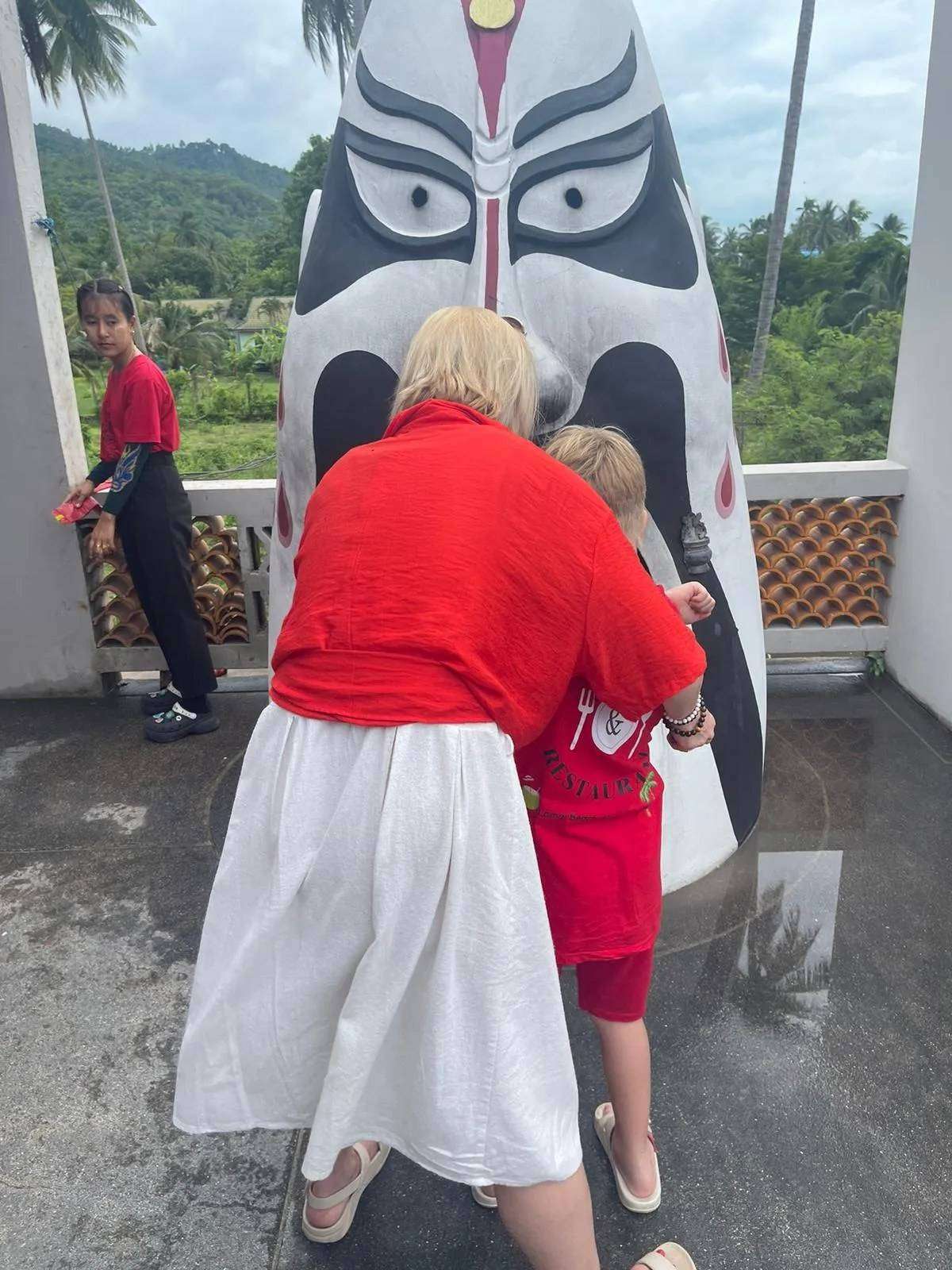
Guan Yu Shrine Koh Samui: 16m Monument
We first glimpsed the shrine from the road in 2016. Eight years later, a return to Hua Thanon took us inside—where a local friend introduced us to the incense, fortune sticks and firecrackers that made the visit unforgettable.
What is the Guan Yu Shrine in Koh Samui?
The Guan Yu Shrine is a Chinese place of worship in Hua Thanon, on Koh Samui’s south-east coast. It is closely connected with the island’s Hainanese Chinese heritage and honours Guan Yu, a historical Chinese general who was later revered as a deity. The monument is widely described as 16 metres tall; a detailed Thai report distinguishes a 12-metre bronze figure from the full 16-metre height including its base.
The shrine stands on Route 4169. Current visitor listings generally show free admission and daytime opening, although their hours differ. Open the Tourism Authority of Thailand map pin, and check the latest local hours before setting out.
For island-wide routes, beaches and practical planning, see our Koh Samui travel guide.
Guan Yu Shrine, Koh Samui: at a glance
| Visitor detail | What to know |
|---|---|
| Location | Hua Thanon, Tambon Maret, on Koh Samui’s south-east coast, beside Route 4169. Open the Tourism Authority of Thailand map pin. |
| Opening hours | Online listings differ. Recent guides show opening around 08:00 or 09:00, usually closing around 17:00; some listings show 18:00. These are third-party times, not a confirmed schedule from the shrine. Check on the day, especially around festivals and public holidays. |
| Entrance fee | Recent visitor guides generally list admission as free. Offerings and ritual items may involve a contribution or purchase; during our 2024 visit we made a small contribution for the items we used. |
| Time to allow | Around 30 minutes for a short look, with longer needed if you explore the complex or take part in a ritual. This is a planning estimate from a current local visitor guide, not a fixed visit duration. |
| What to wear | Choose respectful clothing; local visitor guides advise covering shoulders and knees. Our Thai friend suggested red for our family visit, but we have not found evidence that red is a shrine dress rule. |
| Steps and access | A current local guide describes steps between levels and says the lower courtyard is the easiest area to reach. We have not independently assessed step-free access; contact the shrine before travelling if access is important. |
The exact founding date and statue measurement are not described consistently by published sources. We explain both below rather than repeating the simplest tourist-listing version.
From 2016 Lamai glances to a 2024 Hua Thanon visit
Koh Samui has a way of closing circles. During our 2016 Lamai season—when I was pregnant with Victor—I often drove the long, winding road toward Nathon for prenatal checkups. Every trip through the fishing village of Hua Thanon, I craned my neck for a glimpse of a fierce bronze warrior rising above the coconut palms.
I was endlessly curious about that grand red temple, but morning sickness and island logistics kept us from stopping.
Eight years later, when we returned for Victor’s Windfield year in 2024, we rented a house tucked into Hua Thanon. On our first afternoon unpacking, a chorus of rapid crack-crack-pops rolled through the palms.
I thought it was a neighborhood festival until a Thai neighbor chuckled and pointed down the lane: the firecrackers were from the Guan Yu shrine—a ten-minute walk from the rental lane.
The mysterious temple I had watched from a car window had become our nearest ritual stop. A few weeks later, over dinner with Victor and a close Thai friend, Victor picked at his food while talking about end-of-year exams.
Sensing his nerves, she asked: “Shall we go to the special Chinese temple tomorrow? Whenever I need a boost before a big milestone, I go there to pray.” Her single golden rule? Wear red.
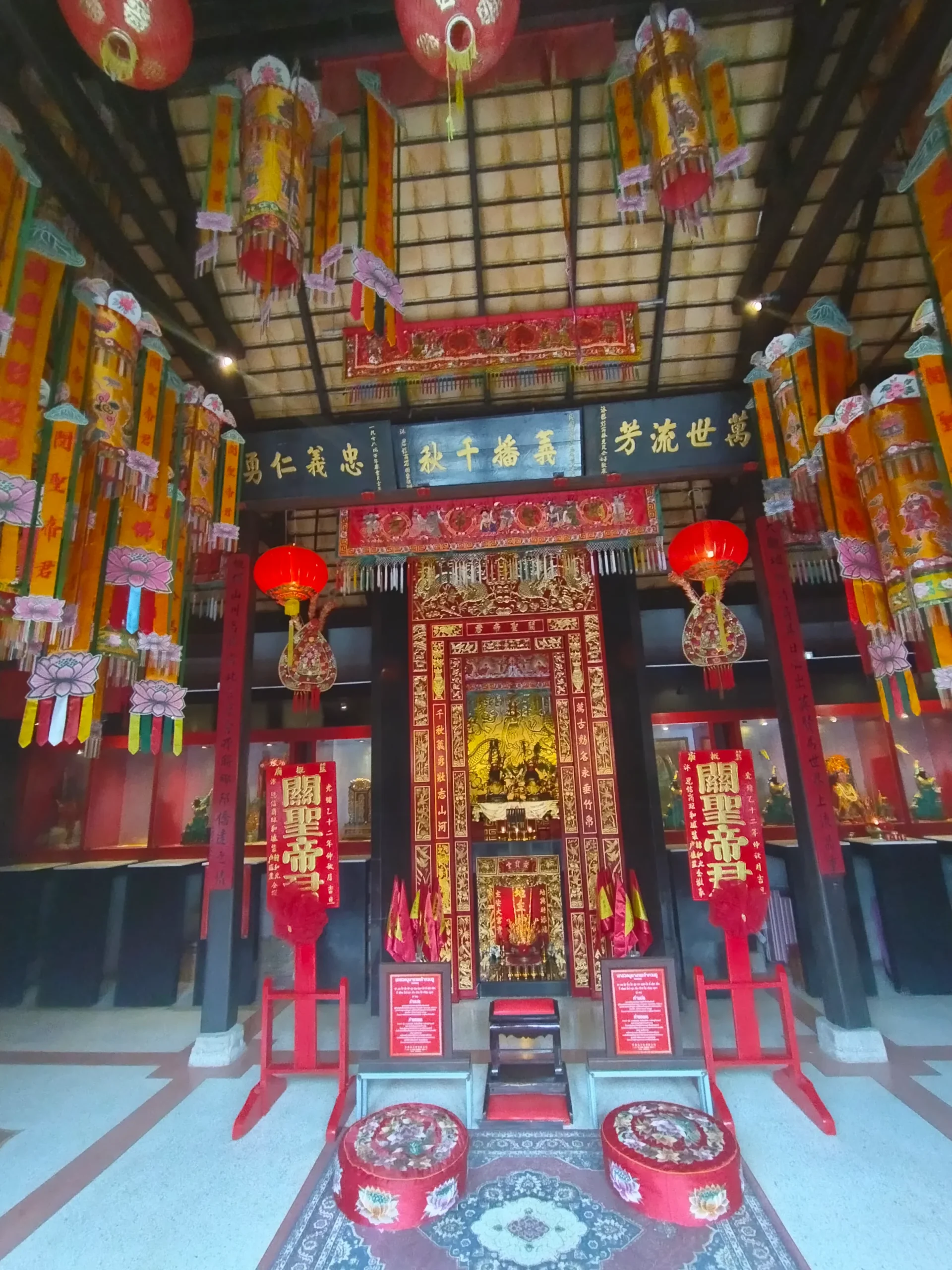
Inside the shrine: incense, Siem Si and firecrackers
We arrived in the quiet early afternoon. Golden light spilled across the courtyard, and we practically had the sanctuary to ourselves. Dressed in our luckiest red, we followed our friend to the donation counter.
For a small contribution, attendants handed us incense, tall candles, gold-leaf prayer papers, and a long string of crimson firecrackers. Staff stepped in with warmth to guide Victor. Their eyes lit up when he explained—earnestly—that he was asking for clarity and a little luck on his science exam.
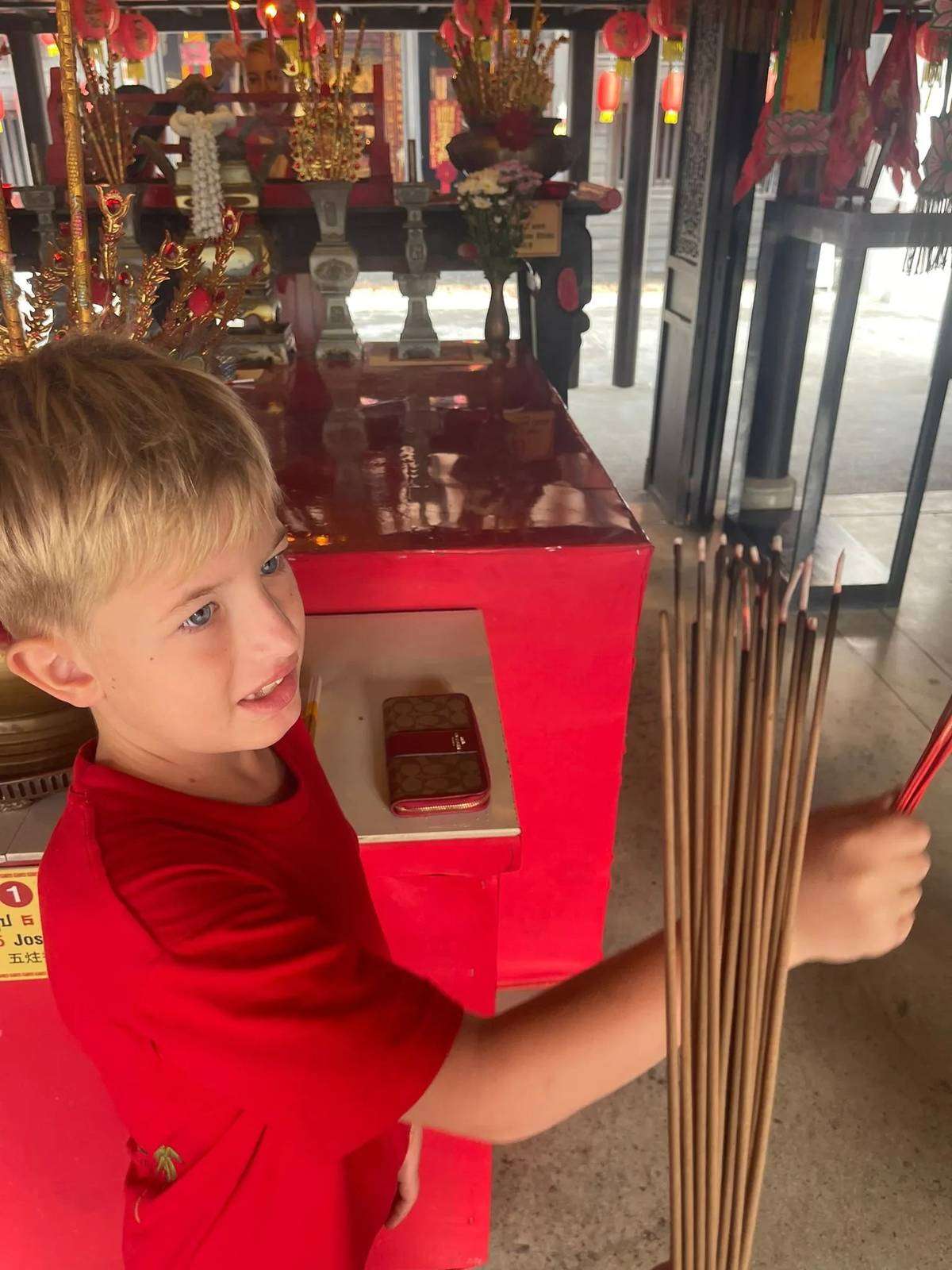
- Outer and inner incense: We lit sticks in the breezy outer courtyard, then placed the rest in brass burners beneath the statue in the main hall.
- Siem Si: We shook a hollow bamboo cylinder until one numbered stick tipped out; the number matched a fortune slip.
- Firecrackers: An attendant hung Victor’s string on a metal frame, handed him a long lighter, and helped him light the fuse. A joyful drumroll of pops echoed through the grounds—Victor’s face pure thrill.
What we noticed: Our early-afternoon visit was quiet, and the courtyard had a calm, unhurried feel while we were there. That is our observation from one visit, not a guarantee that afternoons are always quieter; a current local visitor guide recommends mornings for cooler conditions and softer light.
A week later he bounded through the door with results: every test passed. His trickiest science paper featured the exact topics he had reviewed the night before.
Studying, confidence, or a nudge from General Guan Yu—it became an island memory we still tell.
What Victor remembered after the firecrackers
Victor said the firecrackers were the best part—and that wearing red made the whole visit feel like a team mission before his science exam.
Oliver’s note
Oliver photographed the hall and terrace, kept our cash ready at the donation counter, and reviewed this report for island pacing and etiquette accuracy.
A Hainanese Chinese shrine with nineteenth-century roots
The Guan Yu Shrine is part of Koh Samui’s Hainanese Chinese heritage. The Tourism Authority of Thailand’s Koh Samui points-of-interest listing describes the shrine as more than 150 years old and connects its establishment with the faith of Hainanese Chinese migrants to Surat Thani.
A detailed MGR Online report on the shrine’s history, published on 29 September 2012, traces an earlier Guan Yu shrine to a small wooden building at Ban Na Khai. It says Hainanese Chinese settlers brought a carved image of Guan Yu and two attendant figures there, before the shrine was moved from the Na Khai market area to Hua Thanon. The report describes the older wooden building being retained as the site expanded.
Published accounts do not agree on the shrine’s founding year. MGR Online gives 1872, while Fah Thai magazine’s feature on Hainanese heritage gives 1857. The Tourism Authority of Thailand uses the broader description “more than 150 years old”. These sources do not explain whether they refer to different stages in the shrine’s history, so we describe it as having nineteenth-century roots rather than treating one date as settled.
The present monumental statue belongs to a more recent chapter. Local Koh Samui visitor information records its official opening in January 2016, while earlier reporting documents the community’s work on the enlarged shrine complex. The historic shrine and the large statue visitors see today are related, but they are not the same building or phase of development.
Who was Guan Yu?
Guan Yu—also known as Lord Guan or Guan Gong—was a military general who lived from 160 to 220 CE, during the late Han and Three Kingdoms period in China. The Pew Research Center’s overview of Chinese religious traditions explains how he was honoured after his death as a god of war in popular worship and later held up by Confucian elites as a moral example of loyalty and honesty.
His religious significance developed across different traditions over many centuries. Historian Barend J. ter Haar examines that process in Guan Yu: The Religious Afterlife of a Failed Hero (Oxford University Press, 2017). The details and emphasis vary between communities; it is more accurate to describe Guan Yu as a historical figure later revered in several Chinese religious settings than to suggest that every shrine or worshipper follows one identical practice.
At Hua Thanon, that wider story meets the island’s own Hainanese Chinese history. The shrine is not simply a large statue beside the ring road; it remains part of a local community’s religious and cultural life.
The 16-metre Guan Yu monument: how tall is the statue?
The most useful answer is to distinguish the figure from the full monument. MGR Online’s 2012 report gives the bronze figure as 12 metres high and the total height, including its base, as 16 metres. The Tourism Authority of Thailand and several visitor guides use 16 metres more generally when describing the statue or monument.
That is why we use “16-metre monument” in the title. It describes the full landmark without implying that the bronze figure alone measures 16 metres.
Visiting Guan Yu Shrine in Hua Thanon, Koh Samui
The shrine is in Hua Thanon, on the inland side of Koh Samui’s south-eastern ring road, Route 4169. The Tourism Authority of Thailand’s listing includes a map pin for Guan Yu Shrine. Local visitor listings place it in Tambon Maret, just south of Lamai.
The practical details below bring together the listings available when we checked them on 14 November 2026. They are useful planning references, not a direct confirmation from the shrine committee.
| Detail | What current sources say |
|---|---|
| Location and directions | Hua Thanon, Tambon Maret, Koh Samui, Surat Thani Province, Thailand, beside Route 4169. Use the Tourism Authority of Thailand map pin for navigation. |
| Opening hours | Listings vary: Koh Samui Trips gives approximately 08:00–17:00 (with other listings showing 09:00 or an 18:00 close), while Thai Holiday Guide lists 09:00–17:00 from its Google Maps sync on 11 October 2026. Confirm the hours on the day, particularly near closing or around festivals. |
| Admission | Recent visitor guides generally list admission as free. Offerings and ritual items are separate: during our visit we made a small contribution for incense, candles, prayer papers and firecrackers. Bring a little cash if you may wish to participate, and check local arrangements on arrival. |
| How long to allow | One current local guide suggests around 30 minutes for a straightforward visit. Allow longer if you want time to look around the complex or if a ritual is taking place. |
| Clothing and etiquette | Modest clothing is a respectful choice; visitor guides commonly advise covering shoulders and knees. Red was our Thai friend’s personal suggestion for our family visit, not a confirmed shrine dress code. Follow signs and staff guidance, give worshippers space, and ask before photographing people or ceremonies. |
| Steps and accessibility | Koh Samui Trips’ current guide describes a hillside site with steps between levels and says the lower courtyard is the easiest area to reach. We have not independently checked step-free access; contact the shrine before travelling if this matters to your visit. |
The shrine is a place of worship as well as a landmark. Incense, fortune sticks and firecrackers were part of our own visit, but availability and local practice can vary. Ask the people at the shrine how to take part, and do not handle or light firecrackers unless staff specifically guide you.
For beaches, transport and the wider island context, continue to our Koh Samui travel guide. If you are choosing a base for a family stay, our Where to Stay on Koh Samui with Kids guide compares the island’s main areas through our years of living there. For more regional stories, browse our Asia travel guides.
Frequently asked questions about Guan Yu Shrine
Where is Guan Yu Shrine on Koh Samui?
Is Guan Yu Shrine free to enter?
What are Guan Yu Shrine’s opening hours?
How tall is the Guan Yu statue on Koh Samui?
What should I wear to Guan Yu Shrine?
Is Guan Yu Shrine a Buddhist temple?
Can children visit Guan Yu Shrine?
When is the best time to visit Guan Yu Shrine?
How long should I allow for a visit?
About the author
Natalia Mayerhoffer is a co-founder of Mangoes & Palm Trees and a food and travel contributor. Raised in Krasnoyarsk, Siberia, she brings family food heritage, cultural curiosity and first-hand travel experience to the publication. Read her author profile.
Natalia Mayerhoffer
Co-founder · Food & Travel ContributorAt Mangoes & Palm Trees, Natalia contributes recipe development and cooking, research into food traditions and ingredients, writing and editing, photography, and first-hand family travel stories. For this article, she is the first-person author; Oliver’s photography and editorial input are credited in the story.
The sources behind the shrine’s history and visitor information
Our visit is our own family account. Historical and practical claims below are checked against the named sources; where published accounts disagree, we make that clear.
- Tourism Authority of Thailand. Koh Samui points-of-interest listing (15 August 2022; Thai-language source). Used for the shrine’s Hainanese Chinese community connection, its “more than 150 years” description and the map pin.
- MGR Online. Thai-language report on the Guan Yu shrine and statue (29 September 2012). Used for the earlier wooden shrine, the move to Hua Thanon, the 1872 date and the 12-metre figure / 16-metre total-height measurement.
- Fah Thai magazine, Bangkok Airways. Where the Gods Came Ashore. Used for Hainanese community context and the alternative 1857 establishment date.
- Pew Research Center. Confucianism, Taoism and Chinese folk religions (30 August 2023). Used for Guan Yu’s historical identity and later religious significance.
- Barend J. ter Haar, Oxford University Press. Guan Yu: The Religious Afterlife of a Failed Hero (2017). Scholarly study of Guan Yu’s religious afterlife and development across traditions.
- Koh Samui Trips. Guan Yu Shrine visitor guide (updated November 2026). Used as a third-party visitor reference for approximate time, steps/access, parking and the variation in listed hours.
- Thai Holiday Guide. Guan Yu Shrine attraction listing (Google Maps hours synced 11 October 2026). Used as a second third-party reference for the listed 09:00–17:00 hours and free-admission information.
- We Love Koh Samui. Guan Yu Shrine Samui. Local destination reference recording the modern statue’s official opening in January 2016.
Enjoying our content? Make Mangoes & Palm Trees a preferred source on Google.