Our editorial standards · Thai cooking references, local history and maker details · Not a hands-on product test
Thai kitchen tools · Food culture · Practical buying guide
Thai Granite Mortar vs Molcajete: Which Should You Choose?
If you make Thai curry paste at home, a heavy stone mortar is a familiar choice. But it is not the only mortar used in Thai kitchens—and a Mexican molcajete is not simply a different-looking version of the same tool. The way you pound, mix and serve food matters. Here is how granite, wood, clay and volcanic stone compare, what Ang Sila’s history adds, and what to check before buying.
Start with the dish
Which mortar works best for the way you cook?
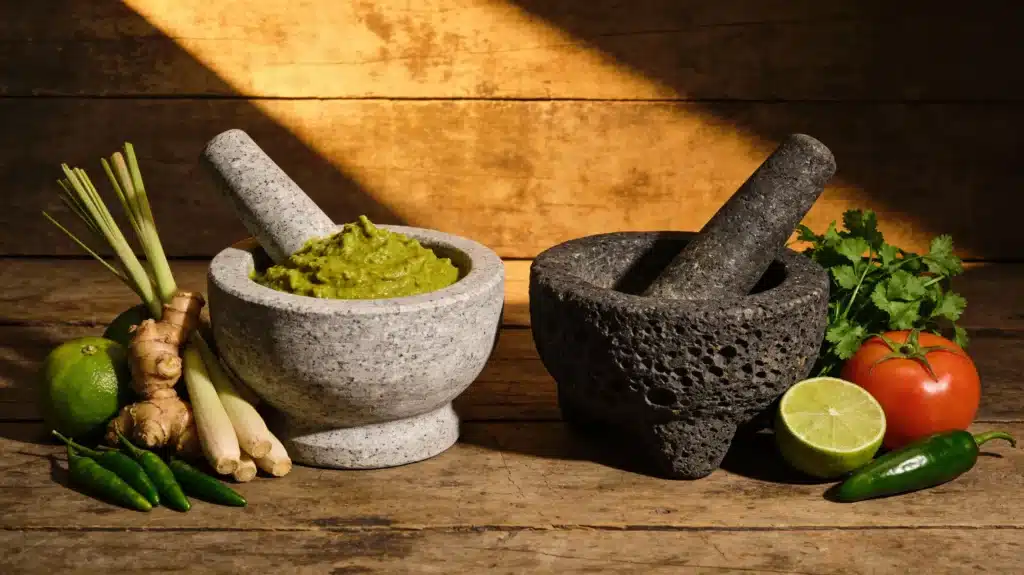
For Thai curry pastes and firm spice grinding, a heavy stone mortar—often granite—is a sensible starting point. For som tam and other salads in the tum family, wooden and clay mortars are also part of Thai kitchen practice, particularly in the North and Northeast. Their gentler pounding action helps bruise and mix ingredients while leaving more of their shape intact.
The best choice depends less on a label than on the food you prepare, the texture you want and the amount you make at a time. A Mexican molcajete belongs in the comparison too: it has its own cooking tradition and can handle more than serving salsa at the table.
| What you are making | A useful starting choice | Why it suits the task |
|---|---|---|
| Thai curry pastes and firm spice grinding | Heavy stone mortar, commonly granite | Weight and a firm grinding surface help break down roots, spices and aromatics into a paste. |
| Som tam and other tums | Wood or clay, depending on style and preference | A gentler pounding action helps bruise and mix ingredients without turning the salad into a smooth mash. |
| Salsa, guacamole and crushed chiles | Molcajete | The broad, textured bowl is made for crushing and mixing, and can also be used for serving. |
| Small batches of dry spices | Small, stable stone or ceramic mortar with a suitably shaped pestle | Interior texture, pestle contact and enough room to keep spices in the bowl matter more than a grand exterior. |
These are practical starting points, not rules that apply to every household. Thai mortar styles and techniques vary by region, cook and dish.
A Thai kitchen has more than one kind of krok
Granite, wood and clay: three Thai mortar styles
In Thai, krok means mortar and sak means pestle. You will also see names that describe the material: krok hin (stone), krok mai (wood) and krok din pao (fired clay). English spellings vary slightly between sources, but the distinction is useful when comparing the tools.
The MICHELIN Guide describes stone mortars—mostly granite—as the sturdy choice for northern Thai curry pastes such as kaeng hang le and nam prik ong, while wood and clay are more often used for papaya salads and other tums. Its guide to traditional Thai kitchen tools also notes the regional role of wooden mortars. For a cook-focused explanation of Thai styles and their use, see Pailin Chongchitnant’s Thai mortar and pestle guide.
Krok hin: stone for pastes and spices
For curry paste and dry spices, a deep, heavy bowl gives the pestle weight to work against and helps keep the mortar steady as you pound. Granite is common in Thai stone mortars. Its weight is useful with firm ingredients such as dried spices, peppercorns, lemongrass, galangal, garlic and chillies. For curry paste, the aim is not merely to chop everything smaller; repeated pounding breaks down fibrous ingredients and brings the mixture together.
Look at the inside as carefully as the outside. A useful grinding surface needs enough texture for the pestle to grip the ingredients. A highly polished decorative bowl may look beautiful on a shelf yet be less useful for the work you intend to do.
Krok mai: wood for a gentler pound
Wooden mortars are associated with the preparation of som tam and other tums, particularly in northern and northeastern Thai cooking. The aim is often to bruise, crack and combine ingredients while leaving their shape and texture recognisable. That gentler action suits preparations where ingredients should be mixed rather than ground into a smooth paste.
Wood is not one uniform material. Species, construction, grain, finish and care instructions all affect the tool. Ask the maker how the mortar should be washed and dried; do not assume that advice for a stone bowl applies to wood.
Krok din pao: clay for salads and lighter pounding
In northern Thai cooking, fired-clay mortars sit alongside wood and stone, with the choice depending on what is being pounded. Clay bodies, glazes and finishes are not all alike, so the maker’s instructions matter here too.
It is worth remembering that these categories describe broad patterns, not a national rulebook. A cook may own several mortars, use a different material from a neighbour, or choose a tool because of the dish being made that day.
A craft shaped by place and time
Ang Sila: the Thai stone-mortar craft behind the name
Ang Sila, on the coast of Chon Buri, is known for its stonework. Its granite mortars have a recognisable shape, often with two opposing ears that give the heavy bowl a place to grip when lifting or washing it. The Ang Sila Municipality’s account of the local stone craft traces the growth of this trade to the years after the Second World War.
The municipal account names a Chinese stonemason, Jek Hwa Sae Tang, who came to work on the stone pillars at Wat Ang Sila. With stone left over from the work, he made a mortar for his own household. Others began making and using them too, and over time the craft became a local trade. The same account describes an older kitchen practice: pounding curry pastes and other foods in wooden mortars, including small shrimp from the sea for kapi, the fermented shrimp paste used in Thai cooking.
That history also matters when buying one today. The Tourism Authority of Thailand’s Ang Sila profile explains that the village’s mortars became known well beyond the area, but similar stone brought in from other provinces is now used to make many of them. The municipality also describes limits on taking local stone and a break in the passing down of some traditional skills.
“Made in Ang Sila” and “quarried in Ang Sila” are not quite the same thing. If the origin matters to you, ask where the raw stone came from, where the mortar was shaped, whether it was carved by hand or machine, and who made it. A place name on a product listing does not answer all four questions.
A little about the stone
Granite or basalt? Look beyond the name
It is tempting to think of granite as sealed and basalt as porous, but natural stone is not that simple. The structure can vary from one piece to another, and the name of the rock does not tell you everything about a finished mortar.
Stone can have tiny pores that connect with one another, allowing water to enter. A European reference on natural stone gives example ranges for open pore space: 0.1–2% by volume for granite and 0.1–6% for basalt. Those ranges overlap, so it is unwise to assume every granite mortar is less porous than every basalt one. They describe pores within the stone, not how much water a finished mortar absorbs.
| Stone | Example amount of open pore space | What to take from it |
|---|---|---|
| Granite | 0.1–2% by volume | Not a guarantee that every granite mortar is sealed or stain-proof. |
| Basalt | 0.1–6% by volume | Not proof that every basalt mortar will hold a particular smell or flavour. |
It is worth keeping the comparison in perspective: the reference describes stone used in buildings, not kitchen equipment. It cannot tell you how a finished mortar will behave with curry paste, washing or repeated use, and it says nothing about food-contact performance. Its value here is simply that it shows why “granite” and “basalt” are not reliable shortcuts for judging an individual bowl.
For a kitchen mortar, look at the finished piece as well as the material: its interior texture, how it was cut or polished, its weight and the care advice from the maker. Those details will tell you more about whether it suits the work you have in mind than a single label on a sales page.
A different cooking tradition
What about a Mexican molcajete?
A molcajete is a traditional Mexican stone mortar, used with a stone pestle called a tejolote. Molcajetes are not all carved from the same stone: Mexico’s National Museum of Anthropology describes one example made from andesite, while Masienda describes its own model as fine-grained lava rock. The bowl is used for crushing and mixing ingredients, from chiles and spices to salsa and guacamole.
The broad bowl and textured surface give a molcajete a character of its own. Masienda describes its model as suitable for salsa, guacamole, spices and chiles, while a separate Serious Eats review of the Masienda model discusses grinding chiles, spices and pastes. Whether it also suits Thai cooking comes down to the particular bowl: its size, weight, texture and the care instructions from its maker.
Some cooks choose to keep separate mortars for strongly flavoured pastes and for salsa or other preparations. That can be a practical way to keep different jobs apart, without assuming every stone bowl will permanently hold the smell of a particular ingredient.
Buy for the work, not just the photograph
How to choose a mortar and pestle
Food Network Kitchen, Serious Eats and Consumer Reports each publish their own hands-on comparisons. Mangoes & Palm Trees has not conducted a side-by-side test of the models listed here, so this guide focuses on the different cooking jobs, published maker specifications and the questions worth asking before you buy.
Start with the food you make most often
If curry pastes and dry spices are the main jobs, look for a substantial stone bowl with enough interior texture for the pestle to grip. If som tam is the priority, consider a wooden or clay style that lets you bruise and mix the ingredients more gently. For salsa and guacamole, a molcajete may be exactly the tool you want.
Check the bowl’s usable capacity
Do not choose by outside diameter alone. Check the internal width and depth, and think about the amount you prepare in one batch. A bowl that is too small lets ingredients jump out; one that is much larger than your usual batch can make small quantities awkward to work.
Look at the pestle and the space for your hand
The pestle should sit comfortably in your hand and make good contact with the bowl. Check its weight, shape and contact area. If the rim is too high or the bowl too narrow, your knuckles may strike the edge while you grind. A comfortable tool is more likely to be used.
Check weight, stability and handling
A heavy bowl can be steady while pounding, but it can also be awkward to lift, wash and store. Look for a base that sits securely on your counter. Handles or the traditional ears on an Ang Sila-style bowl can help when moving it, but they do not make a heavy stone object light.
Ask the seller specific questions
- What stone or material is used, and where was it sourced?
- Where was the mortar shaped, and was it carved by hand or machine?
- Is the inside intentionally rough, ground smooth or polished?
- Does the maker recommend seasoning before first use?
- What are the exact washing, drying and storage instructions?
- Is the mortar intended for food use, and does the seller provide care information?
A little care goes a long way
Seasoning, cleaning and looking after your mortar
There is no single first-use routine for every mortar. Some makers ask you to grind rice before cooking; others give different instructions. Wood, clay and stone also need different care, so keep the directions that came with your own tool.
For its molcajete, Masienda recommends grinding uncooked white rice, discarding it and repeating until the powder stays white rather than grey. The company then advises washing with warm water and a brush, avoiding soap, wiping away excess water and letting the molcajete air-dry. That advice is specific to its product, not a universal rule for every stone mortar.
For everyday use, clear food from the bowl after cooking, follow the maker’s cleaning instructions and let the mortar dry fully before putting it away. Do not put a stone, wooden or clay mortar in the dishwasher unless its maker says it is suitable. A folded tea towel beneath a heavy bowl can help protect the worktop while you pound.
A closer look at real sizes
What do different mortar sizes look like?
Manufacturer listings are useful for seeing how much capacity and weight can vary. The examples below are published specifications from two makers, checked on 5 November 2026. They are not products purchased or tested by Mangoes & Palm Trees.
| Maker and model | Outer × inner diameter | Height | Listed capacity | Listed weight |
|---|---|---|---|---|
| KROK Standard | 17 × 13 cm (6.7 × 5.1 in) | 10.7 cm (4.2 in) | 3 cups | 2.7–3.2 kg (6–7 lb) for the mortar; pestle listed separately |
| Masienda Original | 22.9 × 16.5 cm (9 × 6.5 in) | 13.3 cm (5.25 in) | 4 cups | 9.1 kg (20 lb) |
| Masienda Chico | 17.8 × 14 cm (7 × 5.5 in) | 8 cm (3.15 in) | 2 cups | 3.6 kg (8 lb) |
These are maker-listed measurements and capacities; handmade pieces can vary and product details may change. KROK lists its pestle separately at 19 cm (7.5 in) long and 0.7–0.9 kg (1.5–2 lb). Check the current listing before ordering, and remember that capacity figures are not necessarily measured in exactly the same way by every maker.
A Thai granite example: KROK
KROK’s Standard mortar is listed as hand-carved Thai granite, with a cork base and a 3-cup bowl. The maker also describes its design as “22% lighter”; that is the company’s comparison, not a measurement made by MPT. The listed dimensions and separate pestle weight are worth checking if you are comparing counter space and handling.
A Mexican molcajete example: Masienda
Masienda’s Original and Chico molcajetes show how different two sizes from the same maker can be: the Original is listed at 4 cups and 20 lb, while the Chico is 2 cups and 8 lb. The larger bowl offers more room, but the weight is a real consideration when lifting, washing and storing it.
Bring it back to the kitchen
Choose for the food you make most often
For curry pastes and firm spice grinding, a substantial stone mortar is a good place to start. For som tam and other tums, a wooden or clay bowl may give you the gentler action you want. For salsa, guacamole and chiles, a molcajete brings a different shape and texture to the job. There is no need to make one tool do everything.
Ang Sila’s story adds another question to ask when buying: where did the stone come from, and where was the mortar shaped? Add the bowl’s usable size, weight and care instructions to that list, and you will be choosing for the food you cook rather than for a label on the box.
Enjoying our content? Make Mangoes & Palm Trees a preferred source on Google.
The people and stories behind Mangoes & Palm Trees
Food is one way we get to know a place: through the ingredients people use, the tools in their kitchens and the meals they share. Read more about the family behind this publication and how we approach our stories.
Thai mortar and pestle questions
Which mortar is best for Thai curry paste?
A heavy stone mortar, often granite, is a common choice for Thai curry pastes and firm spice grinding. Choose a bowl with a useful grinding texture, good pestle contact and enough room for the amount you usually make.
What mortar is used for som tam?
Wooden and clay mortars are used for som tam and other tums, particularly in northern and northeastern Thai cooking. Their gentler action helps bruise and mix the ingredients without turning the salad into a smooth paste. The MICHELIN Guide explains the regional distinction.
What do krok hin, krok mai and krok din pao mean?
Krok hin is a stone mortar, krok mai is a wooden mortar and krok din pao is a fired-clay mortar. The names describe the material, not a rule about which tool every cook must use.
Are Ang Sila mortars made from stone quarried in Ang Sila?
Not always. The Tourism Authority of Thailand says many current mortars use similar stone brought in from other provinces. Ask the seller where the stone was quarried and where the bowl was shaped.
Is basalt more porous than granite?
There is no simple rule for every finished mortar. A European reference on natural stone gives overlapping examples for granite and basalt, but it does not test kitchen mortars. The stone name alone cannot tell you exactly how an individual bowl will behave.
Can I use a molcajete for Thai cooking?
Yes, if the bowl’s size, texture and care instructions suit what you want to prepare. Molcajetes are used for grinding spices and chiles as well as making salsa and guacamole; the best choice depends on the particular piece and the way you cook.
Does every new mortar need to be seasoned with rice?
No. Follow the maker’s directions for your particular bowl. Masienda recommends rice seasoning for its molcajete, but that is not a universal instruction for every mortar.
How do I choose the right size?
Check the inner diameter, depth and usable capacity rather than the outside width alone. Leave enough room for your hand and pestle, and think honestly about whether you can lift, wash and store the bowl comfortably.
Sources and guides worth exploring
The links below take you to the Thai cooking guides, local history, maker information and independent comparisons used along the way. They are there for readers who would like to explore a particular tradition, material or product in more detail.
The MICHELIN Guide: Thai kitchen tools
A look at the place of mortar and pestle in Thai kitchens and the traditional tools cooks use.
Nine Traditional Thai Kitchen Tools Thais Can’t Live WithoutThe MICHELIN Guide: northern Thai cooking
Explains how stone, wood and clay mortars are used for different jobs in northern Thai cooking.
Northern Thai Food and Nature: The Role of Natural Materials Inside the KitchenAng Sila Municipality, Chon Buri
The local account of the stone-mortar trade, the familiar two-handled shape and how the craft has changed.
ภูมิปัญญาการทำผลิตภัณฑ์จากหิน — Ang Sila stone-product heritage (Thai)Tourism Authority of Thailand
Ang Sila’s post-war mortar-making history and the stone sourcing used for many products today.
Ang SilaEuropean guidance on natural stone
Offers a useful comparison of open pore space in granite and basalt; it covers building stone, not kitchen mortars.
2017 natural-stone referencePailin Chongchitnant, Hot Thai Kitchen
A cook’s guide to choosing and using Thai-style mortars and pestles.
Ultimate Guide to Thai Mortar and PestleMexico’s National Museum of Anthropology
A collection entry describing one molcajete carved from andesite, a reminder that stone types can differ.
Molcajete — September 2026 collection pieceFood Network Kitchen
A 2026 test of ten mortar and pestle sets, including different sizes and materials.
5 Best Mortar and Pestles of 2026, Tested and ReviewedSerious Eats: mortar and pestle test
A 2026 comparison of mortar and pestle sets, looking at grinding, stability, texture, capacity and cleaning.
The 5 Best Mortar and Pestle Sets of 2026, Tested & ReviewedSerious Eats: Masienda molcajete review
A closer review of the Masienda molcajete and the jobs its rough stone surface can handle.
Masienda’s Molcajete Is the Best We’ve FoundConsumer Reports
A 2026 comparison of eight sets made from granite, marble, wood and stainless steel.
3 Best Mortar and Pestle Sets for Grinding Spices and Vibrant PestosMasienda: product details
The maker’s description, sizes and capacities for its Original and Chico molcajetes.
Masienda MolcajeteMasienda: care advice
Seasoning and cleaning directions for the company’s own molcajete.
Molcajete care in Masienda’s FAQKROK
The maker’s current product listing, including the Standard model’s measurements, capacity and listed weight.
KROK Handmade Thai Granite Mortar and PestleAbout the author
Written by Oliver Mayerhoffer, lead author and publisher.
Oliver Mayerhoffer is the lead author and publisher of Mangoes & Palm Trees. This guide brings together published Thai cooking references, Ang Sila’s local history and current information from makers. It is not a hands-on comparison of the individual mortars listed above.
Our Editorial Policy explains how we distinguish first-hand experience from researched information. Our Affiliate Disclosure explains how commercial relationships are handled across the publication.