Editorial standards: Editorial Policy · Commercial relationships: Affiliate Disclosure
Editorial basis: research-led regional context with selected family memories. The article does not claim family visits to every country or testing of every dish. Image credit: Mangoes & Palm Trees — both AI-generated illustrations were created using OpenAI image-generation tools; they are illustrative, not documentary photographs.
Food culture · Regional dishes · History
Balkan Cuisine Guide: What to Eat & Regional Favourites
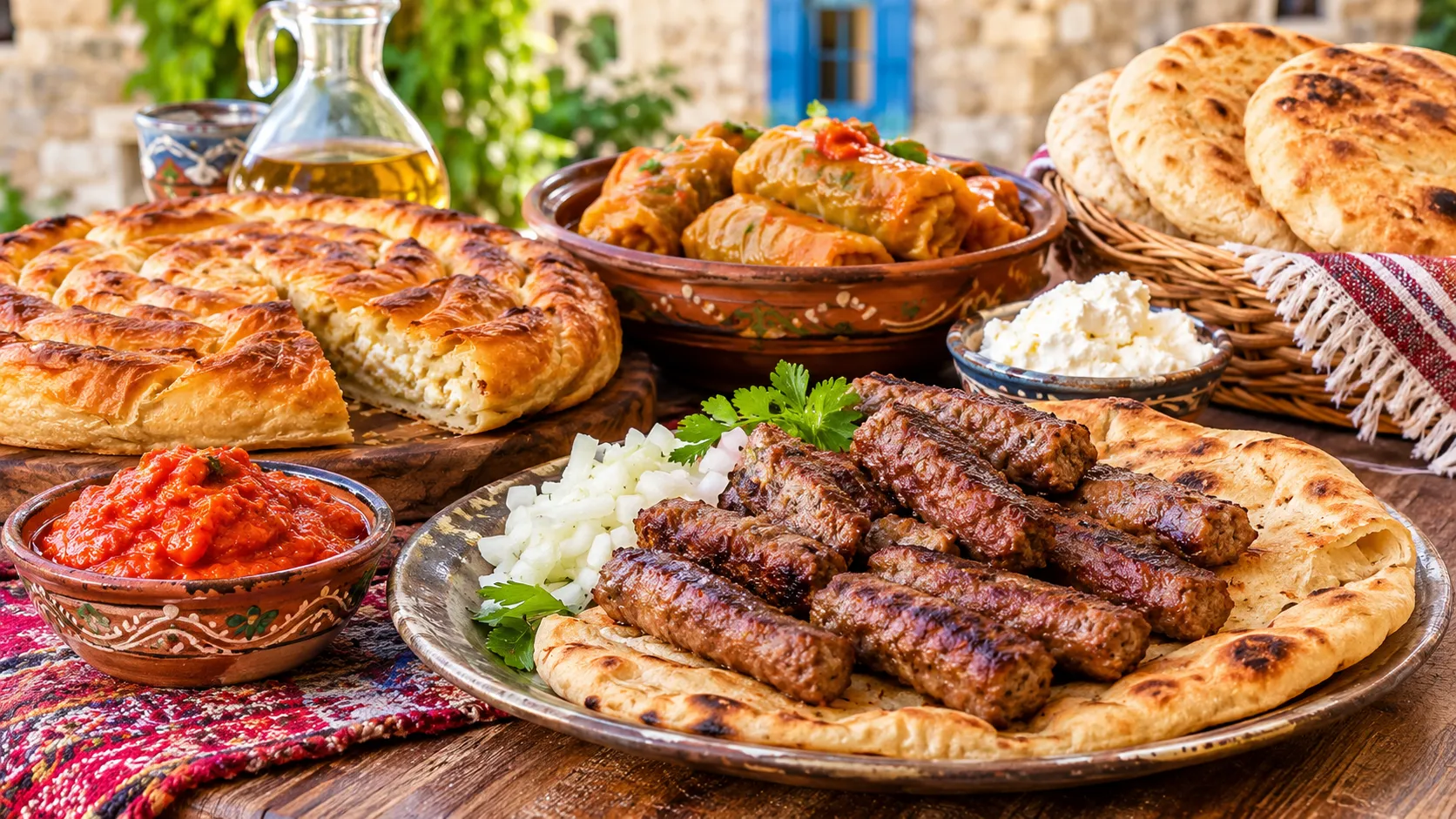
Wondering what to eat in the Balkans? Discover flaky burek, freshly grilled ćevapi, sarma, ajvar and regional specialities, then see how food traditions differ across Southeast Europe. This guide brings together a practical introduction, regional context and selected family memories, with researched information clearly distinguished from first-hand experience.
What is Balkan cuisine?
Balkan cuisine is an umbrella term for the food traditions of Southeast Europe and neighbouring areas. Familiar examples include grilled ćevapi, filled pastries such as burek and banitsa, stuffed leaves such as sarma, roasted-pepper ajvar, bean dishes, coastal seafood, coffee and regional sweets. The geographical scope varies, and recipes and names differ between countries, regions and households.
This is a research-led regional overview with selected personal memories. It is not a claim that the family has visited every country or cooked and tested every dish discussed.
A quick way into Balkan food
- For a first savoury meal: try ćevapi with flatbread and onion, or a locally named filled pastry from a bakery.
- For a vegetable-led side: look for ajvar, seasonal salads, beans or vegetable stews; check whether the dish contains stock, dairy or animal fat.
- For regional contrast: compare inland grilled and baked dishes with Adriatic seafood and olive-oil-based preparations.
- For the wider food culture: make time for local coffee customs, breads, sweets and preserves.
Balkan cuisine at a glance: what should you try first?
If you are meeting Balkan food for the first time, start with one dish, one local side and—where it is part of the place’s food culture—a coffee or sweet. This table is a practical menu guide, not a claim that every dish is eaten in every country.
| Food | What it is | Where it is especially useful to know | What to expect |
|---|---|---|---|
| Burek and related pies | Thin pastry layered or rolled around a filling | Bakery counters across several Balkan food traditions | Flaky, filling and often eaten for breakfast or as a quick meal. Names and filling rules differ by place. |
| Ćevapi | Small skinless grilled minced-meat sausages | Commonly associated with Bosnia and Herzegovina, Serbia and neighbouring food traditions | Usually served with bread and accompaniments such as onion; recipes and portions vary by town. |
| Pljeskavica | A broad, flattened grilled minced-meat patty | Especially familiar in Serbia and nearby areas | Often served with bread, onion or condiments; some versions include cheese or other fillings. |
| Sarma | Filling wrapped in leaves, often cabbage or grape leaves | Multiple Balkan and neighbouring traditions | May be made with meat, rice, vegetables or combinations; sour cabbage is common in some winter versions. |
| Ajvar | Roasted red-pepper spread, sometimes with aubergine | Several Balkan kitchens, including Serbian and North Macedonian food traditions | Smoky, sweet or gently sharp depending on the recipe; served as a spread or accompaniment. |
| Banitsa | Bulgarian layered pastry, often with cheese | Bulgaria | A recognisable bakery or breakfast choice with variations in fillings. |
| Tavče gravče | Beans baked in a traditional earthenware-style dish | North Macedonia | A substantial bean dish; recipes and seasoning vary. |
| Coastal fish and seafood | Grilled or stewed fish, squid, shellfish and other local catch | Adriatic coastal areas, including parts of Croatia and Montenegro | Often served with local vegetables, potatoes, herbs and olive oil; menus depend on season and catch. |
| Local coffee | Strong coffee prepared and served according to local custom | Especially visible in Bosnian and other central Balkan coffee traditions | More than a caffeine stop: sitting for coffee can be part of the social rhythm of a day. |
| Baklava and other sweets | Layered pastries, syrup sweets, cakes or fruit preserves | Different forms appear across several regional traditions | Expect variation in nuts, syrup, dough and serving occasions; do not assume one recipe is universal. |
What does Balkan cuisine mean?
Balkan cuisine is an umbrella term for the food traditions of Southeast Europe and neighbouring areas whose histories overlap through trade, migration, religion, empire and everyday life. It is not one uniform national cuisine. The borders of the Balkans are defined differently in geographical, historical and cultural contexts, and the foods associated with the region do not stop neatly at modern borders.
Across the region, a visitor may encounter grilled minced-meat dishes, filled pastries, stuffed leaves and vegetables, beans, stews, breads, dairy products, roasted-pepper spreads, seasonal vegetables, coffee and sweets. That list is a starting point, not a rulebook. Coastal Dalmatian cooking, for example, can look and taste quite different from the cooking of an inland village; a Bosnian bakery and a Bulgarian breakfast table have their own language and habits.
When I first got to know Balkan food, I began to see how easily a quick description can flatten a place. Calling everything “meat-heavy” misses salads, beans, peppers, pastry and home-preserved produce. Calling everything “Ottoman” misses local histories and later influences. The most useful way to approach the cuisine is to look at particular dishes, the places they belong to, and the variations that people actually make.
How we approach this guide
We separate our own recollections from researched context. The Sarajevo bakery memory and Natalia’s reflection on Serbian sarma are personal stories from our original draft. The country overview and food-history notes are researched context, not a claim that we have visited every place or prepared every dish in the tables. We link to sources where they help explain a historical, product or food-safety point.
Food memory crosses borders, but dishes keep their own identities
Natalia: When Oliver introduced me to Serbian sarma, I thought about the way food carries family memory. My own Siberian and Russian background makes me attentive to the work behind a dish—the preparation, the repetition, the recipes remembered by families, and the reason a particular food appears at a gathering. That does not make sarma and pelmeni the same dish, or prove that they share a direct origin. What I recognise is the family meaning that can travel alongside a recipe.
That distinction matters throughout this guide. Similar techniques can emerge in different places; ingredients can travel; people adapt what they know to what grows locally or is available in a market. A resemblance is worth noticing, but it is not enough on its own to establish where a dish began.
How history shaped Balkan food
The food history of the Balkans is a story of circulation and adaptation, not a simple map coloured by three empires. Ottoman-era foodways left important marks on pastries, stuffed dishes, sweets, coffee culture and grilled foods. Adriatic and Mediterranean connections shaped many coastal traditions. Central European and Habsburg connections affected some northern and inland cooking. Local Slavic, Greek, Albanian, Romanian and other communities also carried their own agricultural practices, religious customs and family traditions. These strands met differently from place to place and changed over time.
Food historians describe the region as a cultural crossroads whose eating habits developed through changing political, religious, commercial and domestic circumstances. Mary C. Neuburger’s research on Bulgarian foodways, for example, traces how local cooking was reshaped by Ottoman, Habsburg, Russian and Soviet influences, as well as by choices made within Bulgaria itself. That is a more useful model than treating any cuisine as a passive product of conquest. See the academic overview, “History of eating habits in the Balkans”, and Neuburger’s Ingredients of Change: The History and Culture of Food in Modern Bulgaria.
The Columbian Exchange: ingredients arrived at different times
Potatoes, tomatoes, peppers and maize originated in the Americas and reached Europe through exchanges that followed 1492, but they were adopted at different rates and in different ways. Their later importance to many Balkan dishes is a reminder that food traditions evolve. It does not mean that every dish containing one of these ingredients was invented at a single moment, or that older cooking techniques and habits suddenly became recent. Recipes are often the meeting point of long-standing practices and newer ingredients. Archaeological research on Ottoman foodways also examines how crops from the Americas entered food systems in the region over time (study of Ottoman foodways and ceramics).
Coffee belongs to a different history. Historical evidence points to Ethiopia as coffee’s origin, with coffee drinking spreading through the Islamic world and the Ottoman Empire before becoming established elsewhere in Europe. The UC Davis Library’s coffee-history exhibit describes this movement. Coffee should not be grouped with crops that originated in the Americas. For a closer look at Bosniak coffee culture as social practice, see the folklore study “Conveying Ćeif”.
Four overlapping influences—not a fixed formula
- Ottoman and wider eastern Mediterranean connections: These help explain the history of many filled pastries, stuffed foods, sweets, coffee customs and grilled dishes. Local versions developed their own names, ingredients and meanings.
- Adriatic and Mediterranean foodways: Along parts of the coast, seafood, olive oil, herbs and local produce are prominent, although every coastal cuisine is not identical.
- Central European connections: In some northern and inland areas, Central European and Habsburg-era traditions are visible in pastries, stews, cured foods and other dishes.
- Local agriculture and family practice: Climate, available ingredients, religious observance, seasonality, preservation and household habits all matter. No single influence explains every plate.
A regional guide to Balkan dishes
The table below is a practical selection of well-known dishes, not an exhaustive or politically definitive list of which countries “count” as Balkan. Depending on the definition being used, discussions of Balkan food may include all or parts of additional countries and border regions. Each country also contains regional differences that a short table cannot capture.
| Country or food tradition | Examples to know | What to look for |
|---|---|---|
| Albania | Byrek, tavë kosi, fërgesë, petulla | Filled pastries and baked dishes, with ingredients and methods that vary between regions and households. |
| Bosnia and Herzegovina | Ćevapi, burek, sirnica, zeljanica, begova čorba | Grilled minced meat, bakery pies and soups. In Bosnian usage, burek conventionally refers to the meat-filled pie; other fillings have their own names. |
| Bulgaria | Banitsa, Shopska salad, tarator, mish-mash | Pastries, salads, dairy and seasonal vegetables. Bulgaria’s official tourism site describes banitsa as a popular breakfast with different fillings. |
| Croatia | Crni rižot, pršut, regional stews, seafood | Dalmatian and Adriatic cooking differs from many inland traditions; local products and preparation methods vary by region. |
| Greece | Moussaka, souvlaki, dolmades and regional pies | Greek cuisine has its own deep regional traditions and Mediterranean connections; it overlaps with, but is not interchangeable with, neighbouring cuisines. |
| Kosovo | Flija, pite and regional baked dishes | Family and local variations matter; use local names and context rather than assuming all pies or fillings are the same. |
| Montenegro | Njeguški pršut, kačamak and coastal seafood | Mountain and coastal settings offer different ingredients and food traditions. |
| North Macedonia | Tavče gravče, ajvar, pastrmajlija | Bean dishes, pepper preparations and baked foods have important local identities and household variations. |
| Romania | Mămăligă, sarmale, ciorbă | Polenta-like cornmeal dishes, stuffed leaves and soups. Romania’s inclusion in definitions of the Balkans varies by context. |
| Serbia | Ćevapi, pljeskavica, sarma, kajmak | Grilled dishes, stuffed leaves and dairy products, with differences between towns, households and restaurants. |
| Slovenia | Štruklji, potica, jota | Regional foodways with Central European, Alpine and neighbouring influences; its classification as Balkan varies with the framework used. |
For an official example, Bulgaria’s tourism authority’s traditional-cuisine guide describes banitsa and Shopska salad among recognised Bulgarian foods. The Tourism Organization of Serbia’s food guide also highlights regional differences within Serbia. These are useful starting points, not substitutes for the detail of a particular region or household.
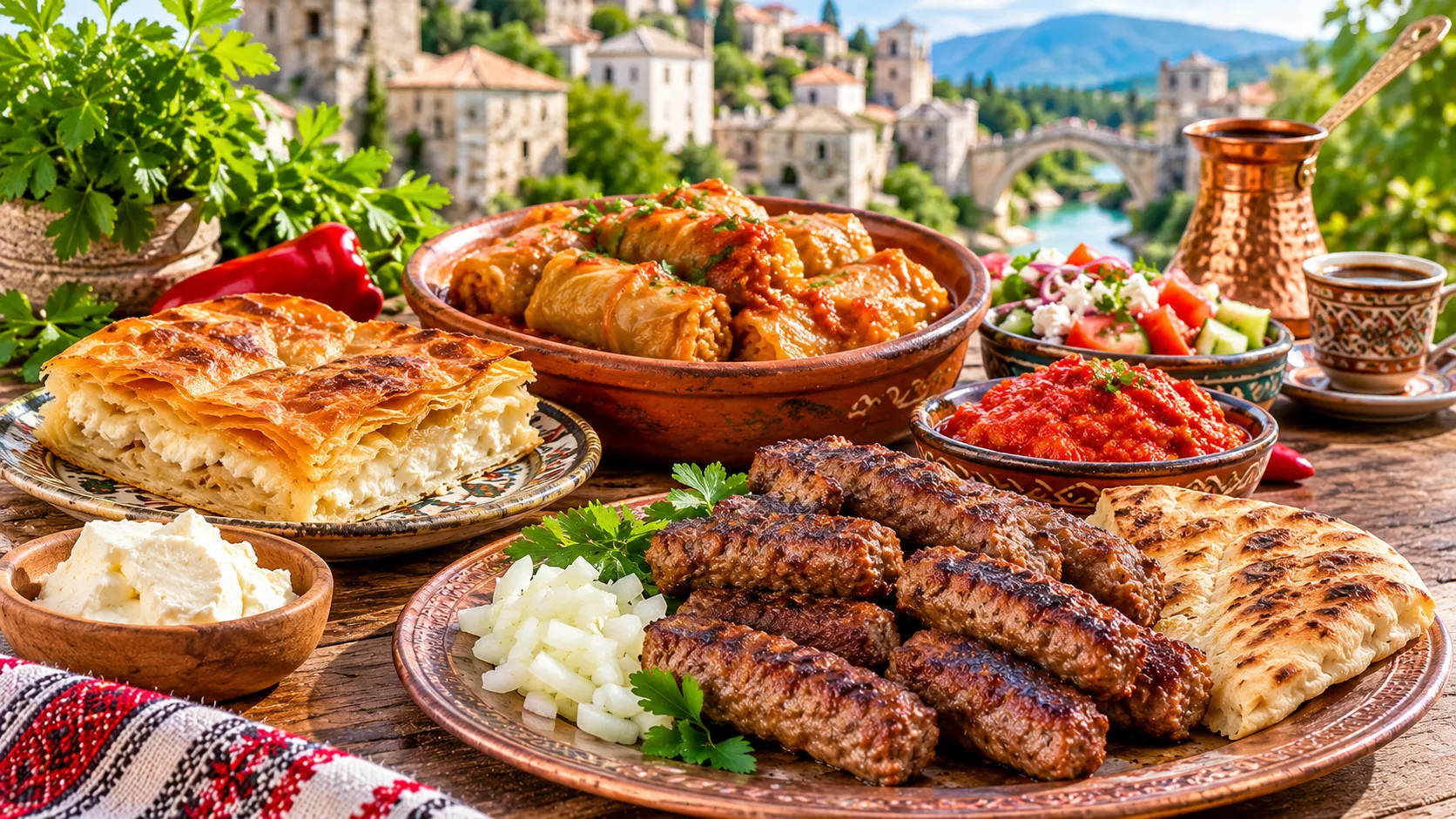
Three dishes that open the door
There are dozens of foods a longer guide could explore. I return to burek, ćevapi and sarma because each offers a different way into the region’s food culture: pastry and naming, grilling and local preference, and the practice of wrapping and cooking a filling in leaves.
Burek, börek, banitsa and byrek: related, but not identical
A filled pastry can look familiar across a border and still belong to a different local tradition. The names, shapes, fillings and conventions surrounding these pastries are part of how people talk about their food. It is worth learning the local term instead of assuming that one label covers everything.
In Bosnia and Herzegovina, burek conventionally means a meat-filled pie. Cheese-filled sirnica, greens-filled zeljanica and potato-filled krompiruša are typically named separately. This is a useful Bosnian distinction, not a universal naming rule for every country. Elsewhere, the broader family of pastries has different words and local conventions.
Bulgarian banitsa is its own well-known pastry tradition, often made with layered dough and fillings such as cheese, spinach, rice or meat; see Bulgaria’s official cuisine guide. Albanian byrek also appears in a range of fillings and shapes. Shared pastry techniques and historical exchange do not make these foods interchangeable.
One memory that stays with me is being offered burek warm from a Sarajevo bakery early in the morning. It changed how I thought about the dish: not simply as a category on a menu, but as something made to be eaten fresh, tied to the rhythm of a working bakery. I use that memory to explain why the details matter; I do not use it as proof that every Balkan pastry follows the same technique.
Ćevapi: small grilled sausages with local variations
Ćevapi (also written ćevapčići in some contexts) are small, skinless sausages made from minced meat and grilled. They are associated with several food traditions across Southeast Europe, including Bosnia and Herzegovina and Serbia. Meat blends, size, seasoning, texture and serving style vary, so a single recipe should not be presented as the universal version.
They are often served with flatbread such as lepinja or somun and accompaniments that may include chopped onion, ajvar or kajmak. The combination depends on the place and the cook. I would not use the presence or absence of one condiment to judge whether a restaurant understands the dish; that turns a living food tradition into an arbitrary test.
The same caution applies to claims about “secret chemistry.” Some recipes use additions intended to affect texture, but baking soda or sparkling water is not a universal requirement for authentic ćevapi. Unless discussing a specific tested recipe, it is more accurate to describe the range of methods and let a source support any technical claim.
Sarma: leaves, fillings and family memory
Sarma describes a family of dishes made by wrapping a filling in leaves. Cabbage and grape leaves are familiar examples, but the tradition is much broader than one wrapper or filling. An ethnobotanical study of Turkey and the Balkans documented the use of many plant leaves in sarma, including fresh and lacto-fermented cabbage, grapevine, beet, sorrel and other leaves. Its findings underline how varied local food knowledge can be: read the study on the ethnobotany of sarma.
In some Balkan households, sour cabbage leaves are especially associated with winter cooking and festive meals. Other versions use grape leaves or other leaves, and fillings may include rice, minced meat, vegetables, herbs or combinations of these ingredients. The word and the technique have travelled, but what goes into the pot remains local.
Natalia: When I think about family food traditions, I think about the hands involved as much as the ingredient list: someone prepares the leaves, someone makes the filling, and someone remembers how a relative rolled them. That is the connection I see between food memories in different parts of Eastern Europe. It is a cultural resemblance, not evidence that two separate dishes share one direct origin.
Fermentation can create the sour flavour and texture of lacto-fermented cabbage, but a fermented leaf is not a guarantee that a finished stuffed dish is preserved or safe at room temperature. Cooking, refrigeration and safe handling still matter. We do not treat sourness alone as a safety test, and we do not make probiotic or medical claims simply because a food is fermented.
Three ingredients that help explain the region’s kitchens
Ajvar, kajmak and Vegeta are useful examples of how foods and products can become familiar across borders without being used in every home or every dish. They are not three universal ingredients, and they do not all belong to the same category: one is a pepper spread, one is a dairy product, and one is a seasoning blend.
Ajvar: roasted pepper spread
Ajvar is a roasted red-pepper spread associated with several Balkan food traditions. Recipes differ: peppers are central, while some versions include aubergine (eggplant), garlic, oil or other ingredients. Roasting helps develop a sweet, smoky flavour; the exact texture and taste depend on the peppers, method and recipe.
Ajvar is served in different ways—as a spread with bread, alongside grilled foods, or as part of a broader meal. It is not accurate to describe every ajvar as fermented. Nor should a long storage life be promised without a tested preservation method and reliable instructions. If using a jarred product, follow the manufacturer’s storage guidance after opening.
Kajmak: a rich dairy product
Kajmak is a traditional dairy product associated especially with Serbia and neighbouring areas. A food-quality study describes it as a rich top layer formed during the cooling of boiled milk; traditional production and maturation vary, and researchers note that product quality can vary considerably. The 2023 study on the quality of Serbian kajmak is a useful reference.
Depending on the style, kajmak may be fresh or matured, and its texture and flavour are not identical to sour cream or Greek yoghurt. It can accompany grilled meat or bread, but the way it is used varies by place and household.
A safety note: this guide does not provide a homemade kajmak fermentation recipe. Leaving cream at room temperature for several days, judging it by smell and assuming a fixed shelf life is not a validated safety process. The USDA advises that perishable food should not remain unrefrigerated for extended periods; that general rule is not a substitute for a tested, product-specific dairy process. See the USDA food-safety guidance. Choose a reputable product and follow its handling instructions.
Vegeta: a Croatian seasoning blend
Vegeta is a commercial seasoning blend created by Croatian company Podravka. The company’s history dates its creation to 1959, when Zlata Bartl and her team developed the blend originally called Vegeta 40. The manufacturer’s history of Vegeta provides the chronology. Product formulations vary, so check the ingredient panel on the specific package rather than assuming every version contains precisely the same ingredients.
For cooks, the useful point is simple: a seasoning blend can provide a familiar savoury flavour quickly, but it is not a requirement of Balkan cooking and it is not found in every kitchen. Some cooks use commercial seasoning; others season with salt, pepper, herbs, vegetables, stock or their own spice combinations.
MSG without the culture-war language
Monosodium glutamate (MSG) is the sodium salt of glutamic acid, which contributes savoury taste. The US Food and Drug Administration considers added MSG generally recognised as safe. The FDA also notes that reports of sensitivity exist and that controlled studies have not consistently reproduced reactions. Its questions and answers on MSG explain the evidence and its limits. That is a more accurate summary than claiming that every concern has been “debunked” or that every person has the same response.
Coffee, bread, sweets and drinks: the rest of the table
A cuisine guide becomes more useful when it covers more than the main course. Breakfast counters, coffee breaks, side dishes and sweets reveal local habits too, although the details vary by country and family. These are starting points to look for, not a fixed Balkan menu.
Coffee as a social pause
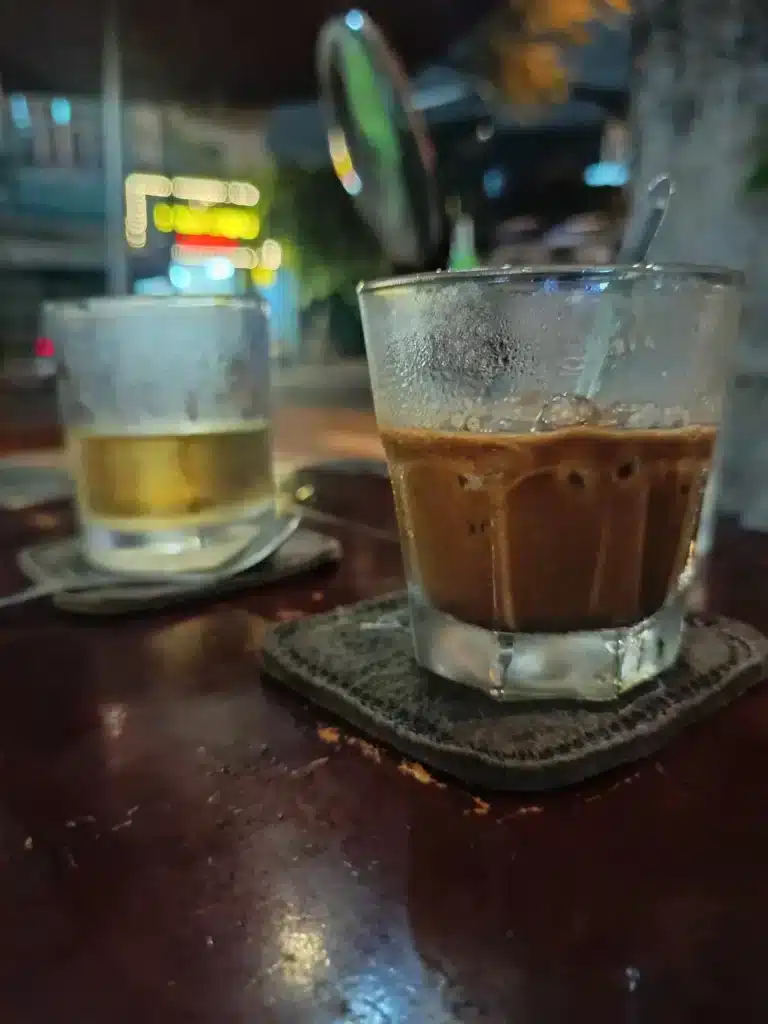
In Bosnia and Herzegovina, Bosnian coffee is an important part of hospitality and social life. It is traditionally prepared in a small pot and served in a small cup; the grounds settle as the coffee rests. Preparation and serving conventions differ across the region, so it is better to learn the local custom than to label every strong coffee “Turkish coffee.” The UC Davis Library coffee-history exhibit offers context for how coffee drinking spread through the Ottoman and wider European worlds.
Bakery food and breakfast
Filled pastries can be a quick breakfast, a snack or a full meal. Look for the specific local name on the bakery counter and ask what the filling contains. In Bosnia, the distinction between burek and other named pies is particularly clear; Bulgarian banitsa and Albanian byrek have their own traditions. Bread, yoghurt, cheese, eggs, cured meats and vegetables may also feature at breakfast, but the exact combination is not universal.
Sweets and festive food
Baklava and other syrup pastries are found in several Balkan and neighbouring traditions, with regional differences in dough, nuts, syrup and presentation. Other places have their own cakes, fruit preserves and baked sweets. The occasion matters: some dishes are associated with holidays, visits, coffee or celebrations rather than everyday meals. Ask what a local sweet is called and how it is usually served instead of assuming it is the same dessert under a different name.
Rakija and other drinks
Rakija is a fruit brandy familiar in several Balkan food and hospitality settings, with fruit, production method and strength varying by place and producer. Wine, beer, mineral water, fruit juices and coffee are also part of different local tables. Alcohol is not required for a full experience; ask for water, juice or coffee if that suits you better, and treat homemade spirits cautiously because their strength can vary.
Balkan food is more varied than a grill menu
Grilled meat and filled pastries are among the region’s most recognisable dishes, but they do not tell the whole story. Beans, vegetable stews, salads, soups, breads, dairy foods, cornmeal dishes and seasonal produce matter too. The balance changes by geography, religion, season, household and whether you are eating in a coastal town, a city bakery or a rural home.
How to find vegetarian options
Vegetarian choices exist, but the ingredients and cooking fats should be checked rather than assumed. A dish based on vegetables may still contain stock, dairy or animal fat; beans may be cooked with smoked meat; pastries may contain cheese, eggs or butter. Ask about the preparation, not just the dish’s name. If you avoid animal products entirely, clarify dairy, egg and broth ingredients as well.
- Look for: ajvar, seasonal salads, some bean dishes, vegetable stews, grilled vegetables and clearly described vegetable fillings.
- Ask about: meat stock in soups and beans, lard or animal fat in baked dishes, and dairy or eggs in pastry.
- For allergies: tell the cook directly and ask about shared utensils and preparation surfaces; a dish name alone cannot confirm suitability.
Coastal and inland food can be quite different
On parts of the Adriatic coast, menus may place more emphasis on fish, squid, shellfish, olive oil, herbs and seasonal vegetables. Inland and mountain regions may offer more grilled meat, dairy, preserved foods, breads and slow-cooked stews. These are broad patterns, not rules for every town or restaurant. The Tourism Organization of Serbia’s regional food overview, for example, describes differences within Serbia itself, from dough-based foods in the north to regional meat, dairy and grain traditions elsewhere.
A simple way to plan a day of Balkan eating
For travellers, it can help to think about a day of eating rather than trying to tick off a checklist of “must-eats”. The examples below are flexible ways to explore food; they are not a schedule shared by every Balkan country.
| Moment | What to look for | Useful question |
|---|---|---|
| Morning | A local bakery, filled pastry, bread, dairy or eggs | “What is this pastry called here, and what is the filling?” |
| Lunch | A grill, stew, beans or a regional baked dish | “What comes with it, and is the portion usually shared?” |
| Coastal meal | Local fish or seafood with seasonal sides | “What is local or in season today?” |
| Coffee break | Local coffee preparation and a small sweet if desired | “How is coffee usually served here?” |
| Shopping or picnic | Ajvar, bread, cheese, olives, preserves and seasonal produce | “Does this need refrigeration after opening?” |
Food becomes easier to understand when you let local names and habits lead. If the same dish appears in two countries, compare the version in front of you rather than treating one as the definitive original and the other as a copy.
Is Balkan cuisine healthy?
There is no single nutritional profile for the region. A meal may combine legumes, grains, vegetables, dairy, meat, fish, pastry or sweets in many different proportions. Some traditional patterns make good use of vegetables, beans and seasonal produce; other dishes are rich in salt, saturated fat or energy. The answer depends on the dish, the preparation, the portion and the person eating it.
Fermented foods deserve the same precision. Fermentation changes flavour and can change the microorganisms present, but not all fermented foods contain live microorganisms at the point of eating, and not every live microorganism has a demonstrated health benefit. The NIH consumer fact sheet on probiotics explains why broad claims about digestion or immunity should be treated carefully. We describe the food and tradition without promising a medical outcome.
Sources and further reading
These sources support selected historical, culinary, product and food-safety points in this guide. They are not presented as proof that every regional version of a dish is the same.
- “History of eating habits in the Balkans”, in Nutritional and Health Aspects of Food in the Balkans (Academic Press, 2021).
- Mary C. Neuburger, Ingredients of Change: The History and Culture of Food in Modern Bulgaria (Cornell University Press, 2022).
- “They Were Just Eating to Live”: The Social Archaeology of Ottoman Foodways and Ceramics (2023).
- UC Davis Library, “Brewed Awakening: The Evolution of the Coffee Industry.”
- “Conveying Ćeif: Three Croatian Folklore and Folklife Writings on Bosniak Coffee Culture.”
- “Of the importance of a leaf: the ethnobotany of sarma in Turkey and the Balkans.”
- Bulgaria Travel, “Traditional Cuisine.”
- Tourism Organization of Serbia, “Taste of Serbia.”
- Vegeta, “History of Vegeta.”
- “Challenges in Evaluating Quality of the Serbian Traditional Dairy Product Kajmak,” Journal of Food Quality (2023).
- US Food and Drug Administration, “Questions and Answers on Monosodium Glutamate (MSG).”
- US National Institutes of Health, Office of Dietary Supplements, “Probiotics: Consumer Fact Sheet.”
- USDA Food Safety and Inspection Service, “What is the Danger Zone?”
Editorial note: Cuisine names, ingredients and customs vary within countries and between households. We prefer a precise regional description to a universal claim about what every family eats or how every dish must be prepared.
Balkan cuisine questions
What is Balkan cuisine?
Balkan cuisine is an umbrella term for related but distinct food traditions across Southeast Europe and neighbouring areas. Common examples include filled pastries, grilled minced-meat dishes, stuffed leaves and vegetables, bean dishes, pepper spreads, coastal seafood, coffee and regional sweets. The exact scope of the Balkans varies by geographical, historical and cultural definition.
What are the best-known Balkan dishes?
Good starting points include burek and other filled pastries, ćevapi, pljeskavica, sarma, ajvar, banitsa, tavče gravče, regional stews and coastal seafood. Which dishes are most characteristic depends on the country and region; no short list represents every Balkan kitchen.
What is the difference between burek, börek, banitsa and byrek?
They belong to related filled-pastry traditions, but the names and local conventions differ. In Bosnia and Herzegovina, burek conventionally means a meat-filled pie, while sirnica, zeljanica and krompiruša are commonly used for cheese, greens and potato fillings. Bulgarian banitsa and Albanian byrek have their own regional forms.
Is Balkan food vegetarian-friendly?
There are vegetarian dishes, including ajvar, many salads, beans, vegetable stews and some pastries. Check how each dish is made: soups and beans may contain meat stock or smoked meat, while pastry can contain cheese, eggs or dairy. Ask the cook about the actual ingredients rather than relying on a dish name.
Is Balkan food spicy?
Not necessarily. Many dishes are savoury, smoky, tangy, herby or mild. Some condiments and regional dishes contain hot peppers, but heat varies by recipe and cook. Ask for chili or hot sauce on the side if you prefer to control the level.
What do people drink with Balkan food?
Coffee is an important part of social life in many places, with local preparation and serving customs. Depending on the country and occasion, meals may also be accompanied by local mineral water, juices, wine or rakija, a fruit brandy. Drinking customs and preferred drinks vary by region and household.
Is Balkan cuisine healthy?
There is no single nutritional profile for the region. Meals can include vegetables, legumes, grains, dairy, meat, seafood, pastries and sweets in different proportions. Whether a meal fits someone’s needs depends on the specific ingredients, preparation, portion and individual dietary requirements.
Which countries are included in the Balkans?
There is no single universally accepted list for every context. Geography, history and cultural usage draw the region’s boundaries differently, and some countries are included in full while others are included only in part. A food guide should explain its scope instead of presenting one list as definitive.
Is fermentation essential to Balkan cuisine?
Fermentation and preserved foods are important in some regional traditions, including sour cabbage used in certain sarma preparations. They are not present in every dish, and not every product in this guide is fermented. Fermentation alone is not proof that a food is safe or that it provides a specific health benefit.
Enjoying our content? Make Mangoes & Palm Trees a preferred source on Google.