Editorial policy: our editorial standards · affiliate disclosure
Baked Greek yogurt cheesecake · Almond butter · Granola crust
Almond Butter Greek Yogurt Cheesecake with Granola Crust
A baked cheesecake-style dessert with thick Greek yogurt, almond butter and a crisp granola base. Follow the full method for gentle baking, safe cooling and clean slices.
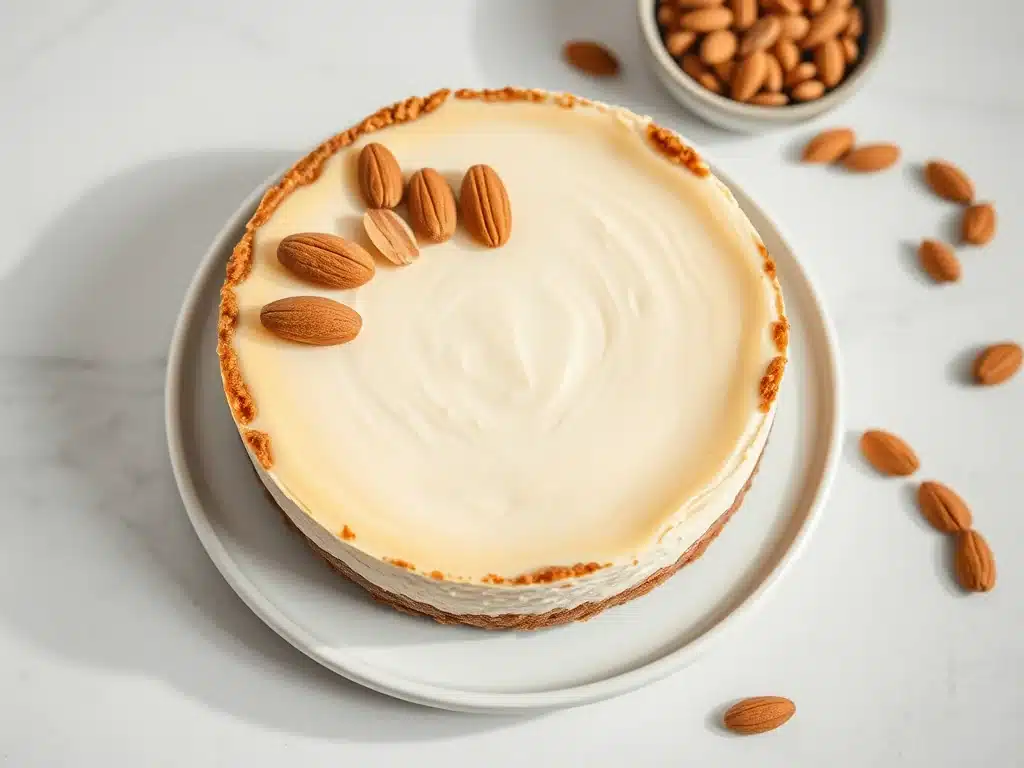
Almond butter Greek yogurt cheesecake with a granola crust and almond garnish.
How do you make Greek yogurt cheesecake with a granola crust?
Press granola crumbs with coconut oil and honey or maple syrup into a springform pan, then add a filling made from thick Greek yogurt, almond butter, eggs, vanilla and cornstarch. Bake until the egg-based centre reaches 160°F (71°C), cool gradually and refrigerate for at least four hours before slicing. This version does not contain cream cheese.
Greek yogurt cheesecake at a glance
- Crust: Granola, coconut oil, honey or maple syrup, and a little salt.
- Filling: Full-fat Greek yogurt, almond butter, eggs, vanilla and cornstarch; no cream cheese.
- Yield: 12 slices from a 9-inch springform pan.
- Timing: About 25 minutes prep, up to 50 minutes baking, gradual cooling and at least 4 hours chilling.
- Food safety: Check the egg-based centre with a thermometer and refrigerate promptly.
The recipe and what to expect
A Greek yogurt cheesecake with almond butter and a granola base
This is a baked cheesecake-style dessert built around thick Greek yogurt rather than a cream-cheese filling. Almond butter gives the yogurt mixture body and a nutty flavour, while eggs and a little cornstarch help it set. The base is made from crushed granola bound with coconut oil and honey or maple syrup.
That distinction matters when you shop and bake: there is no cream cheese in this version. The filling is softer and more delicate than a conventional cream-cheese cheesecake, so it needs a full chill before you release the springform ring or cut it into slices.
Because this filling contains no cream cheese, it has a different texture from a conventional cream-cheese cheesecake. The thickness of the yogurt and almond butter, gentle mixing, careful baking and a full chill all affect how cleanly it slices.
The base
What makes the granola crust hold together?
Granola needs to be crushed into fairly even crumbs so the coconut oil and sweetener can coat it. Press the mixture firmly and evenly into the bottom of the pan, paying particular attention to the edge where the base can become loose. The short pre-bake helps the crust set before the filling is added.
Let the crust cool before you pour in the yogurt mixture. If it is still hot, it can warm the filling unevenly. The finished base is a granola crumb crust, not a pastry shell, so handle the chilled cheesecake carefully when removing it from the pan.
The filling
Why use thick, full-fat Greek yogurt?
Greek yogurt has had some of its whey strained away, giving it a thicker consistency than regular plain yogurt. That thicker starting point is useful here because the filling has no cream cheese. Full-fat yogurt is specified in the recipe; changing to a thinner or lower-fat product can change the texture and how firmly the cheesecake sets.
Bring the yogurt, almond butter and eggs closer to room temperature before mixing. Stir the almond butter thoroughly first if oil has separated in the jar. Mix the eggs in gently and stop once they are incorporated; beating the filling heavily can add air that expands in the oven and settles as the cake cools.
Oven, cooling and clean slices
How to bake and cool a yogurt cheesecake
The recipe uses two oven temperatures: 350°F (175°C) for the crust, then 325°F (165°C) for the filling. The stated 35–40 minute filling bake is a guide, not a substitute for checking doneness. Because the mixture contains eggs, the FDA advises cooking egg dishes to 160°F (71°C); use a food thermometer in the centre rather than relying on appearance or a gentle wobble alone.
Once baked, a gradual cool can help limit sudden temperature changes. The method below leaves the cheesecake in the switched-off oven with the door slightly ajar, then moves it to a rack before refrigeration. Do not leave an egg-and-dairy dessert at room temperature beyond the safe time limits in the storage section.
Chill the cake for at least four hours before slicing. A longer chill, such as overnight, makes it easier to release the springform ring and cut clean portions. Warm the knife briefly, dry it, and wipe the blade between slices.
The complete recipe
Almond Butter Greek Yogurt Cheesecake with Granola Crust
A baked filling of full-fat Greek yogurt and almond butter over a granola crust bound with coconut oil and honey or maple syrup. This recipe contains no cream cheese. Cool gradually and chill thoroughly before serving.
Yield: 12 slices · Prep: 25 minutes · Bake: about 50 minutes · Cooling: about 1 hour · Chill: at least 4 hours · Total: about 6 hours 15 minutes
Ingredients
For the granola crust
- 2 cups granola
- 1/4 cup coconut oil, melted and slightly cooled
- 2 tablespoons honey or pure maple syrup
- 1/4 teaspoon fine sea salt
For the Greek yogurt filling
- 2 cups full-fat plain Greek yogurt, at room temperature
- 1/2 cup smooth unsweetened almond butter, well stirred and at room temperature
- 1/3 cup honey or pure maple syrup
- 2 large eggs, at room temperature
- 1 teaspoon pure vanilla extract
- 1 tablespoon cornstarch
- 1/8 teaspoon fine sea salt
Method
- Prepare the pan. Heat the oven to 350°F (175°C). Lightly grease a 9-inch springform pan and line the base with parchment paper.
- Make the granola crust. Pulse the granola into coarse crumbs. Stir in the melted coconut oil, 2 tablespoons of honey or maple syrup, and 1/4 teaspoon of salt until the crumbs are evenly moistened. Press firmly over the base of the prepared pan.
- Pre-bake the crust. Bake the crust for 10 minutes. Set it on a rack to cool while you make the filling, and reduce the oven temperature to 325°F (165°C).
- Mix the yogurt and almond butter. Whisk the Greek yogurt until smooth. Add the almond butter, 1/3 cup of honey or maple syrup, and vanilla. Stir until evenly combined.
- Add the eggs and starch. Add the eggs one at a time, mixing gently after each addition. Fold in the cornstarch and 1/8 teaspoon of salt just until no dry streaks remain. Avoid beating air into the mixture.
- Bake the cheesecake. Pour the filling over the cooled crust and level the top. Bake at 325°F (165°C) for about 35 to 40 minutes, until the edges are set. Check the centre with a food thermometer; because the filling contains eggs, it should reach 160°F (71°C). Do not rely on the wobble alone as a food-safety check.
- Cool gradually. Turn off the oven and leave the door slightly ajar for about 30 minutes. Transfer the pan to a rack and cool only until it is no longer hot, then cover and refrigerate promptly. Keep the total time out of refrigeration within the food-safety limits below; in a room above 90°F (32°C), refrigerate within 1 hour.
- Chill before slicing. Cover the cheesecake and refrigerate for at least 4 hours, or until thoroughly chilled and firm enough to slice. Run a thin knife around the edge before releasing the springform ring. For neat slices, use a warm, dry knife and wipe it between cuts.
Food-safety note: The centre of the egg-containing filling should reach 160°F (71°C). Refrigerate promptly after cooling; do not leave the cheesecake out beyond the limits described below.
Make-ahead and leftovers
How to store Greek yogurt cheesecake
Make the cheesecake ahead so it has time to chill fully. Once cooled, cover it and keep it refrigerated at 40°F (4°C) or below. USDA guidance says safely refrigerated leftovers should be used within three to four days.
Because this dessert contains eggs and dairy, do not leave it at room temperature for more than two hours, or more than one hour if the temperature is above 90°F (32°C). In a warm kitchen, shorten the cooling time and move it into the refrigerator promptly. These are food-safety limits, not a guarantee that the texture will remain unchanged for the entire storage period.
More from the dessert archive
Keep exploring our dessert recipes
If you are planning a dessert table, browse the wider collection or try another baked favourite from the archive.
Greek yogurt cheesecake: common questions
Can I use regular yogurt instead of Greek yogurt?
Use thick, full-fat Greek yogurt for this recipe. If you only have regular plain yogurt, strain it in the refrigerator through cheesecloth or a fine sieve until thick, then measure it. Unstrained yogurt contains more liquid and can leave the filling too loose.
Does this cheesecake contain cream cheese?
No. This version uses Greek yogurt and almond butter in the filling; cream cheese is not included in the ingredient list. Adding it would change the balance of the recipe and would need a separate test.
How do I stop the granola crust from crumbling?
Pulse the granola to an even, coarse crumb, mix it thoroughly with the coconut oil and sweetener, then press it firmly into the pan. Let the baked crust cool before adding the filling. A granola crust is more delicate than a traditional biscuit crust, so slice with a warm, dry knife.
Can I make the cheesecake ahead?
Yes. It needs at least 4 hours in the refrigerator to chill and firm, so making it the day before is convenient. Keep it covered and refrigerated until serving.
How long does Greek yogurt cheesecake keep?
Cover and refrigerate it at 40°F (4°C) or below. Use refrigerated leftovers within 3 to 4 days, and do not leave this egg-and-dairy dessert at room temperature for more than 2 hours, or 1 hour when the temperature is above 90°F (32°C).
Sources for egg safety and chilled storage
These official references support the food-safety advice in this recipe. They do not represent testing, endorsement or nutritional analysis of the MPT formula.
U.S. Food and Drug Administration
Egg-containing dishes should be cooked to 160°F; use a food thermometer to check.
What You Need to Know About Egg SafetyUSDA Food Safety and Inspection Service
Perishable leftovers should be refrigerated within two hours and used within three to four days when safely stored.
How Long Are My Take Out Leftovers Safe?Centers for Disease Control and Prevention
Keep refrigerators at 40°F or below and refrigerate perishable food promptly.
Preventing Food PoisoningThe people behind Mangoes & Palm Trees
Food and travel stories shaped by family life, curiosity and care for the details behind what we share.

Oliver Mayerhoffer
Lead Author · PublisherOliver leads the writing and publishing at Mangoes & Palm Trees. He writes about food, hospitality, travel, people and family life, distinguishing personal experience from information that needs research or a current check.
Read our editorial policy and affiliate disclosure.
Enjoying our content? Make Mangoes & Palm Trees a preferred source on Google.