Ingredient guide · cooking methods · research-led
15 Ground Bison Recipes: Juicy, Lean, Weeknight-Fast
Ground bison has half the fat of 80/20 beef. That means flavor without grease — if you respect the temperature. This research-led guide covers 15 dish types with practical technique notes: sear hot, add fat or broth, pull at 155°F, rest three minutes so carry-over heat hits the safe 160°F. USDA-ground-meat safety applied across burgers, meatballs, chili, tacos, stroganoff, and more.
What are the best ground bison recipes for families?
The best ground bison recipes cook lean meat quickly over medium-high heat, add fat or broth to prevent dryness, and reach 160°F on an instant-read thermometer. This research-led guide outlines 15 dish types — burgers, meatballs, chili, tacos, skillet bowls — with the core technique: sear fast, add moisture, rest three minutes off heat.
At a glance
- Temperature: Pull at 155°F, rest three minutes — carry-over heat reaches 160°F (USDA).
- Moisture: Add 1 tbsp oil or broth per pound; don’t over-mix.
- For burgers: Sear 3 minutes per side, don’t press.
- For chili/tacos: Brown fast, then simmer with liquid.
- Safe handling: Keep raw bison separate from ready-to-eat foods; wash surfaces after.
This guide synthesizes USDA safety standards and culinary technique sources. For our tested family recipes, see the Recipe Index.
Why this guide exists
I first cooked ground bison in a rental kitchen in Da Nang during our 2026 Southeast Asia fieldwork. We were craving something familiar but lighter than beef. Natalia found a kilo at a market carrying imported meats. I made burgers — seared hard, rested three minutes — and they worked. Juicy, clean flavor, no grease pooling.
Since then I’ve looked into the technique across sources: USDA safety data, culinary texts, chef interviews. The pattern is consistent. Bison is lean (~7g fat/100g vs ~20g for 80/20 beef). That means two things: it cooks 20–30% faster, and it needs added moisture. The fix is simple — oil in the pan, broth in the pot, don’t overcook. This guide collects what the sources agree on.
Evidence label: Research-led. The dish types below are culinary categories with technique synthesis, not individually tested MPT recipes. Our one tested data point: the burger method (Da Nang, 2026).
What makes ground bison different
Bison isn’t “better” than beef — it’s different. The muscle fibers are finer, the fat content lower, the flavor slightly sweeter. In practical terms:
- Cook time: 20–30% less than beef for the same doneness.
- Moisture loss: No fat cap to baste the meat. You add it or you lose it.
- Temperature window: Ground bison must hit 160°F per USDA. That leaves almost no margin.
Treat it like a technique ingredient. Respect the heat, add the fat, rest the meat. Do that and it works across burgers, meatballs, Asian stir-fries, Mexican bakes, Italian braises.
15 ground bison dish types — research synthesis
These are culinary categories with technique notes drawn from source consensus. They are not MPT-tested recipes unless marked. The structure for each: typical method, key technique, common pairings.
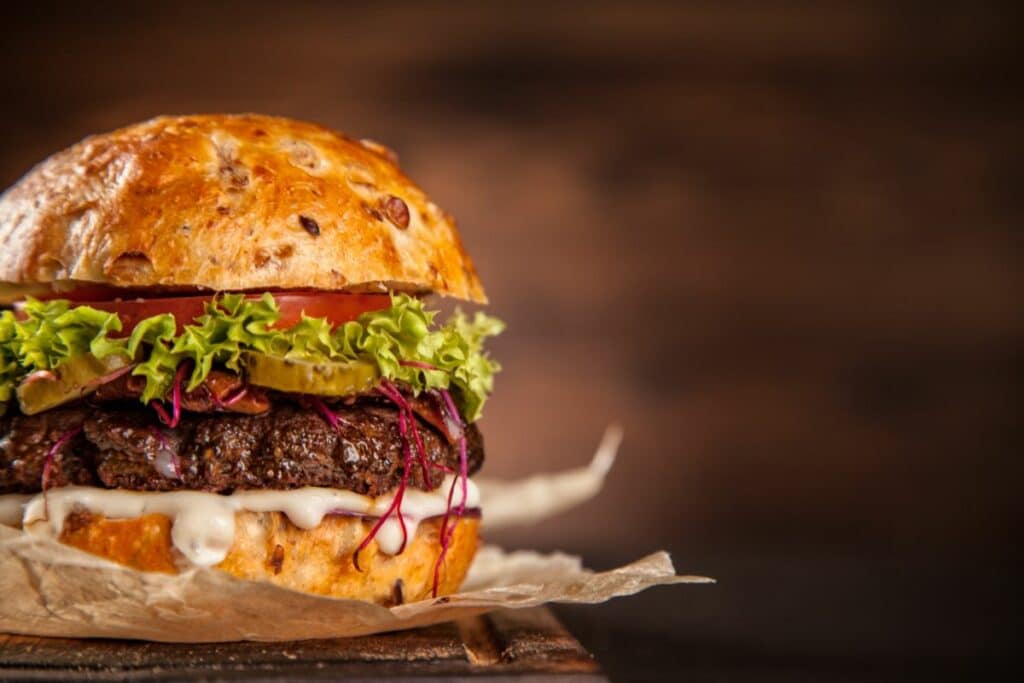
Bison Burger
High-heat sear, pull at 155°F, rest three minutes. Carry-over heat reaches 160°F. The rest rule is the single most cited technique across sources.
Synthesized method
- 01Form loose patties slightly larger than buns. Don’t overwork.
- 02Heat heavy skillet medium-high. Add 1 tbsp oil per pound. Sear 3 minutes per side.
- 03Check thickest patty: 155°F target. Remove, tent, rest 3 minutes.
- 04Toast buns in hot pan. Assemble.
Source consensus USDA 160°F + culinary sources on rest time. MPT single test confirms juiciness.
Bison Meatballs
Simmered in sauce. The lean meat absorbs liquid instead of releasing fat. Binders (egg, breadcrumb, cheese) are critical — more than for beef.
Source consensus Italian culinary texts + USDA safe temp. Not MPT-tested.
Shepherd’s Pie with Ground Bison
Browned filling under mash. Lean meat means no grease layer. Mash soaks juices. Bake until topping browns.
Source consensus British/Irish culinary sources adapted for lean meat. Not MPT-tested.
Bison Chili
Bison Tacos
Bison Stroganoff
Mexican Bison Bake
Cajun Bison Dirty Rice
Bison Lettuce Wraps
Bison Kofta with Yogurt Sauce
Bison Bolognese
Bison Sliders
Bison Stuffed Peppers
Bison Breakfast Hash
Bison Kofta Kebabs
Which cooking method for which dish type
| Method | Dish types | Core technique |
|---|---|---|
| Pan-sear + rest | Burgers, sliders, kebabs | Pull at 155°F, rest 3 min — carry-over hits 160°F |
| Simmer in sauce | Meatballs, bolognese, stroganoff | Gentle bubble 25+ min — meat absorbs liquid |
| High-heat sear + broth | Tacos, lettuce wraps, kofta | Brown fast, splash liquid, toss — done in minutes |
| Bake with topping | Shepherd’s pie, stuffed peppers, Mexican bake | 375–400°F until topping browns — filling stays moist |
| Long simmer | Chili, dirty rice | 45+ min — flavors marry, meat tenderizes |
Practical techniques (source synthesis)
The moisture rule
One tablespoon of oil or broth per pound of bison. Mix gently before forming, or add to pan. Universal across sources.
Don’t over-mix
Whether burgers or meatballs, handle minimally. Overworked bison gets dense. Mix until just combined.
The three-minute rest
Non-negotiable for burgers/sliders. Pull at 155°F, tent, wait. Protein fibers relax and reabsorb juice. Cut early = juice on cutting board.
Temperature over time
Minutes vary by pan, burner, patty size. 155°F/68°C on instant-read is the only reliable signal.
Equipment that helps
- Cast iron skillet: Even heat, holds temp when cold meat hits.
- Instant-read thermometer: Only way to hit 155°F consistently.
- Wide pot for simmering: Meatballs need room; crowded = steamed.
- Rimmed baking sheet: Sliders/kebabs — catches drips, single layer.
Common problems and fixes (source synthesis)
| Problem | Cause | Fix |
|---|---|---|
| Burger dry and gray | Overcooked past 160°F | Pull at 155°F, rest 3 minutes |
| Meatballs dense | Over-mixed | Mix until just combined |
| Meatballs fall apart | Insufficient binder | 1 egg + ½ cup panko per pound |
| Taco meat dry | No liquid after browning | Splash broth, toss |
| Chili greasy (expectation) | Beef habit | Bison doesn’t need draining — skip drain step |
Food safety, storage, and reheating (USDA/FDA)
- Purchase: Cold to touch, no gray patches. Use/freeze within 1–2 days.
- Thaw: Refrigerator overnight. Never counter-thaw.
- Cook: 160°F (71°C) minimum per USDA. Color unreliable — use thermometer.
- Store cooked: Refrigerate within 2 hours (1 hour if >90°F/32°C). Use 3–4 days.
- Freeze cooked: Cool completely, portion, freeze up to 3 months.
- Reheat: 165°F (74°C) for leftovers. Add broth to restore moisture.
- Cross-contamination: Separate boards/utensils for raw bison. Wash with hot soapy water.
Full guidance: FDA Safe Food Handling.
Questions about ground bison
Is ground bison drier than ground beef?
Yes, significantly. Bison has ~7g fat/100g vs ~20g for 80/20 beef. Add 1 tbsp oil or broth per pound, don’t over-mix, pull at 155°F with 3-minute rest.
Can I swap bison one-to-one for beef in recipes?
Yes in most recipes. Reduce cook time 20–30%, add moisture (oil, broth, sauce), use thermometer. Season after browning for better control.
What temperature should ground bison be cooked to?
160°F (71°C) minimum per USDA. Pull at 155°F and rest 3 minutes — carry-over heat reaches 160°F. Color is not a reliable indicator.
Why do my bison burgers fall apart?
Over-mixing or insufficient binder. For burgers, handle gently — don’t compress. For meatballs, use egg and panko (½ cup panko + 1 egg per pound).
Can I eat bison medium-rare?
Whole cuts (steaks, roasts) can be medium-rare (130–135°F). Ground bison must reach 160°F because grinding distributes surface bacteria throughout.
How long does ground bison last in the fridge?
1–2 days raw. 3–4 days cooked. Freeze if longer — up to 4 months raw, 3 months cooked for best quality.
Sources for temperature and safety guidance
This guide synthesizes the two primary USDA/FDA sources below. Culinary technique consensus comes from standard professional texts.
USDA Food Safety and Inspection Service
Safe minimum internal temperature 160°F (71°C) for ground meats including bison.
Ground Meat and Food SafetyU.S. Food and Drug Administration
Safe food handling: clean, separate, cook, chill. Ground meat temperatures and cross-contamination prevention.
Safe Food HandlingEnjoying our content? Make Mangoes & Palm Trees a preferred source on Google.



Where this guide fits in our archive
More lean protein, weeknight mains, and family cooking context.
Meet the Mayerhoffers
Recipes, places and people — kept in context and shared with care.

Oliver Mayerhoffer
Lead Author · Father · PublisherOliver leads the editorial work, looking for the useful detail that gives a reader a clearer sense of a meal, a place or a decision.

Natalia Mayerhoffer
Co-founder · Teacher · Dentist by trainingNatalia grew up in Krasnoyarsk, where food and family traditions were part of everyday life. A dentist by training and a teacher, she brings those experiences to the recipes and stories she helps create.
Our aim is to keep useful knowledge and meaningful stories together: recipes worth making, places worth understanding and the people whose traditions give them context.
Explore Our Recipes